
Abstract
Abstract In Tanzania, over 90% of pregnant women attend at least one ANC visit, only 51% complete the recommended four or more visits which is still below the WHO-recommended eight visits. This study examines the determinants and extent of ANC utilization among women of reproductive age in Tanzania. The study draws on data from the 2022 Tanzania Demographic and Health Survey. A sample of 15, 254 women of reproductive age (15-49) was included in the study. Using the Double-Hurdle Model, the study analysed both the decision to seek ANC and the frequency of visits. The results show that husband’s age positively affects ANC utilization (p < 0.01), while it negatively affects the number of visits (p < 0.01). Husband’s higher education significantly increases ANC utilization (p < 0.05), and women’s secondary education increases the number of ANC visits (p < 0.05). Women’s employment significantly increases ANC utilization (p < 0.01), while husband’s employment increases the frequency of visits (p < 0.01). Women in poorer (p < 0.05), middle (p < 0.01), richer (p < 0.01), and richest households (p < 0.05) are more likely to utilize ANC services, while women in richer (p < 0.05) and richest households (p < 0.01) make more visits. Distance to a health facility slightly increases ANC utilization (p < 0.05). Walking (p < 0.01), using cars or trucks (p < 0.01), and public buses (p < 0.01) increase ANC utilization, while cars or trucks also increase visit frequency (p < 0.10). Employer-provided insurance (p < 0.01) and social security insurance (p < 0.01) increasing the likelihood of ANC use. Regarding information exposure, reading newspapers reduces ANC utilization (p < 0.01), whereas listening to the radio increases utilization (p < 0.01). Finally, reliance on public health facilities significantly reduces both ANC utilization (p < 0.01) and the number of visits (p < 0.05). The study emphasizes expanding maternal health education programs and promoting male partner involvement in ANC decision-making could enhance overall maternal health outcomes in Tanzania.
Keywords
Antenatal Care Double-Hurdle Model Frequency of Visits Healthcare Utilization Women of Reproductive Age.
Introduction
Antenatal care (ANC) is a fundamental component of maternal and child health services, providing pregnant women with essential preventive and clinical care aimed at detecting complications early and improving maternal and neonatal outcomes [2]. The World Health Organization (WHO) recommends a minimum of eight antenatal contacts during pregnancy to ensure effective monitoring of maternal and fetal health [32]. In high-income countries, ANC coverage is almost universal due to well-developed healthcare systems, broader financial protection mechanisms, and higher levels of maternal education and health literacy (Allotey et al., 2020). Nevertheless, disparities remain even in these settings, particularly among marginalized groups such as immigrants, rural residents, and low-income populations who may face social, economic, or cultural barriers to accessing healthcare services [31].
Globally, several initiatives have been implemented to strengthen maternal healthcare and improve ANC coverage. These include the Safe Motherhood Initiative, the Millennium Development Goals (MDGs), and more recently, the Sustainable Development Goals (SDGs), particularly SDG 3, which aims to reduce global maternal mortality and improve access to essential reproductive health services (UN, 2023). International organizations such as WHO, UNICEF, and the World Bank have also supported programs that expand skilled maternal healthcare, promote universal health coverage, and strengthen primary healthcare systems. Strategies such as free maternal healthcare policies, conditional cash transfer programs, community health education campaigns, and digital health interventions have been introduced in many countries to encourage early and consistent ANC attendance (WHO, 2022, World Bank, 2023; [29]). Despite these global efforts, significant gaps remain in many low- and middle-income countries (LMICs), where women continue to face barriers such as financial constraints, long travel distances to health facilities, inadequate healthcare infrastructure, and limited awareness of maternal health services [8].
Maternal and neonatal mortality remain major public health challenges in sub-Saharan Africa, where rates are among the highest globally, and inadequate utilisation of antenatal care (ANC) services continues to contribute significantly to these outcomes. Although many pregnant women attend at least one ANC visit, a large proportion fail to initiate care early or complete the recommended number of visits, which limits early detection and management of pregnancy-related complications [32]. Selebano and Ataguba (2022) indicate that insufficient ANC attendance remains strongly associated with persistent maternal and neonatal mortality across many low- and lower-middle-income countries in the region, where healthcare systems often face structural and resource constraints. In 2016, the World Health Organization revised its ANC guidelines, increasing the recommended schedule from the earlier four focused visits to a minimum of eight contacts during pregnancy to improve maternal and neonatal outcomes; however, adherence to this recommendation remains low across much of sub-Saharan Africa [32]. Studies across African LMICs show that ANC utilisation is frequently inconsistent or delayed due to socioeconomic challenges such as poverty, limited decision-making autonomy among women, and inadequate awareness of the importance of early and regular ANC attendance [17]. In Nigeria, for instance, while many women attend at least one ANC visit, fewer than half complete the recommended four visits and only a small proportion reach the WHO-recommended eight contacts, largely due to socioeconomic inequality, transportation costs, and disparities in healthcare infrastructure. Similar trends are observed in Ethiopia, where ANC utilisation remains uneven across regions, particularly in rural areas where women often attend fewer than four visits because of poverty, limited access to health facilities, and reliance on traditional birth practices [27]. Evidence from a systematic review by Alibhai et al. (2022) further demonstrates that urban women generally have better access to ANC services than rural women, who face barriers such as long distances to health facilities, shortages of skilled healthcare providers, inadequate transportation infrastructure, and cultural preferences for traditional birth attendants. In response, several African governments have introduced policy interventions including free maternity services, conditional cash transfers, and community-based health programs aimed at reducing financial barriers and improving access to maternal healthcare services; however, the quality of care remains a concern because many health facilities continue to experience shortages of essential medical supplies, inadequate diagnostic equipment, and high patient-to-provider ratios that limit effective service delivery [21]. Consequently, despite ongoing policy efforts to expand maternal healthcare access, adherence to the WHO recommendation of at least eight ANC contacts during pregnancy remains limited across many countries in sub-Saharan Africa.
East African countries, including Kenya, Uganda, and Tanzania, have made gradual progress in strengthening maternal healthcare services over the past two decades; however, significant challenges in antenatal care (ANC) utilisation persist across the region. Although policy reforms and expanded maternal health programs have improved access to healthcare facilities, the uptake of ANC services remains uneven between and within countries. Some countries have recorded improvements in the proportion of women attending at least one ANC visit, yet adherence to the recommended number of visits continues to be relatively low in several rural and underserved areas [9]. In Ethiopia, for example, the government has implemented community-based health programs that deploy community health workers to promote maternal health awareness and encourage women to attend ANC services. While these initiatives have increased initial contact with healthcare providers, sociocultural barriers and traditional beliefs surrounding pregnancy continue to limit their effectiveness in ensuring consistent attendance [1]. Similarly, in Uganda, financial incentives and health education campaigns have been introduced to promote ANC utilisation; however, their impact has been inconsistent due to health system inefficiencies, limited infrastructure, and shortages of trained healthcare personnel [15]. Another critical challenge across East Africa concerns the quality of maternal healthcare services provided at health facilities. Many women report negative experiences during ANC visits, including long waiting times, inadequate communication with healthcare providers, disrespectful treatment, and shortages of essential medicines [6]. These negative facility-level experiences discourage repeat visits and reduce adherence to recommended ANC schedules. As a result, inadequate and irregular ANC utilisation increases the risk of preventable pregnancy complications such as preeclampsia, maternal anaemia, and neonatal infections, which continue to contribute to maternal and neonatal morbidity in the region.
Tanzania has made notable progress in maternal healthcare over the past decade, yet significant challenges remain. The government has adopted policies aimed at increasing ANC visits, such as the integration of free maternity services and community outreach programs [25]. Together with SDG Target 3.1 aims to reduce the global maternal mortality ratio to less than 70 per 100,000 live births by 2030 which aim to ensure universal access to quality maternal healthcare, including adequate ANC visits [32]. Despite these efforts, many women, particularly those in rural and semi-urban areas, still face difficulties in accessing quality maternal healthcare [19]. The 2022 Tanzania Demographic and Health Survey reported that while 90% of pregnant women in Tanzania attend at least one ANC visit, only 51% complete four or more visits, which falls significantly below the WHO recommended eight visits standard for improving maternal health outcomes (TDHS, 2022). This gap suggests that Tanzania is not fully meeting SDG Target 3.8, which emphasizes achieving universal health coverage, including access to essential healthcare services. However, there has been extensive research on antenatal healthcare utilization, where most studies ([25]; Selebano and Ataguba, 2022; [6]; [21]; [31]) have been conducted at the district level, limiting their generalizability to broader populations. This study addresses this gap by examining the determinants and extent of ANC utilization at the national level using the recently updated 2022 TDHS-MIS dataset, offering a more comprehensive and policy-relevant analysis.
Theoretical Review
The Human Capital Theory
The Human Capital Theory, developed by Michael [10], explains how individuals invest in their health to improve productivity, well-being, and long-term economic outcomes. In this framework, health is treated as a form of capital like education or skills, meaning individuals allocate resources such as time, income, and knowledge to maintain or improve their health status. Grossman conceptualizes this relationship through a utility function where individuals derive satisfaction from both health and other goods. This can be expressed as:
Where U represents individual utility, H represents the stock of health, and Z denotes the consumption of other goods and services. Within the context of maternal healthcare, pregnant women invest in antenatal care (ANC) services as part of their health investment decisions because improved maternal health contributes to better neonatal outcomes and overall household welfare.
According to the theory, health is not fixed but evolves over time depending on investment and natural deterioration. The health stock accumulation process can be represented as:
Where Hₜ represents the existing health stock at time t, Iₜ denotes investment in health (such as antenatal care visits, nutrition, and medical services), and δHₜ represents the rate at which health depreciates due to aging, illness, or environmental factors. During pregnancy, ANC services function as an important health investment that helps maintain and improve maternal health capital. Women who understand the long-term benefits of preventive care are therefore more likely to seek ANC services early and attend the recommended visits. Empirical evidence shows that women with higher levels of education are more likely to recognize these benefits and invest in maternal healthcare [24].
Human Capital Theory also emphasizes that the demand for healthcare is derived from the demand for health itself. Health outcomes are produced through a combination of medical care and socioeconomic inputs. This relationship is often represented by the health production function:
Where, M represents medical inputs such as antenatal healthcare services, E represents education, T represents time allocated to health-producing activities, and X represents other socioeconomic determinants such as income and environmental conditions. Education plays a critical role in ANC utilization because educated women are better able to understand pregnancy risks, health information, and the importance of preventive healthcare. Similarly, income and household wealth influence the ability to afford healthcare services, transportation, and other costs associated with accessing health facilities ([25]; [22]). In contrast, financial limitations, high transport costs, and opportunity costs such as loss of working hours can reduce ANC utilization, particularly in rural and low-income settings [21].
From a demand perspective, the utilization of antenatal healthcare services can also be modelled using a health demand equation derived from Human Capital Theory. The probability of antenatal care utilization can be represented as:
where represents antenatal care utilization for woman i, represents education level, represents household income or wealth status, represents access to healthcare services (such as distance, transportation, or facility availability) and represents the random error term. This equation highlights that ANC utilization depends on socioeconomic and accessibility factors that influence women’s health investment decisions. Education improves health literacy and awareness of pregnancy risks, while income determines the ability to afford healthcare services and transportation costs ([25]; [22]). Conversely, financial limitations, long travel distances, and high opportunity costs reduce the likelihood of attending antenatal services, particularly in low-income and rural settings ([21]; [6]).
Furthermore, the number of antenatal visits undertaken during pregnancy can represent the intensity of maternal health investment. This can be modelled as:
Where represents the number of ANC visits, represents maternal education, represents household wealth status, represents accessibility factors such as distance to healthcare facilities and transportation, represents exposure to health information through media or community health programs, and represents the stochastic error term. Access to healthcare infrastructure and information plays an important role in shaping maternal health investment decisions. Beyond individual economic decisions, access to healthcare infrastructure and information also shapes maternal health investment. The availability of healthcare facilities, skilled medical personnel, and affordable services determines whether women can translate their health preferences into actual healthcare utilization [11]. In many developing countries, long travel distances, inadequate health infrastructure, and shortages of healthcare professionals discourage frequent ANC attendance. Furthermore, health knowledge and awareness influence how women interpret health information and make informed healthcare decisions. Exposure to health education programs, media campaigns, and community outreach initiatives can significantly improve maternal health literacy and increase ANC uptake [8]. Government policies such as free maternity services, health insurance programs, and conditional incentives for ANC visits further reduce financial barriers and encourage women to invest in maternal healthcare [31]. Therefore, Human Capital Theory highlights that improving education, income opportunities, healthcare accessibility, and health information systems enhance antenatal care utilization and maternal health outcomes.
The Andersen and Newman Healthcare Utilization Model
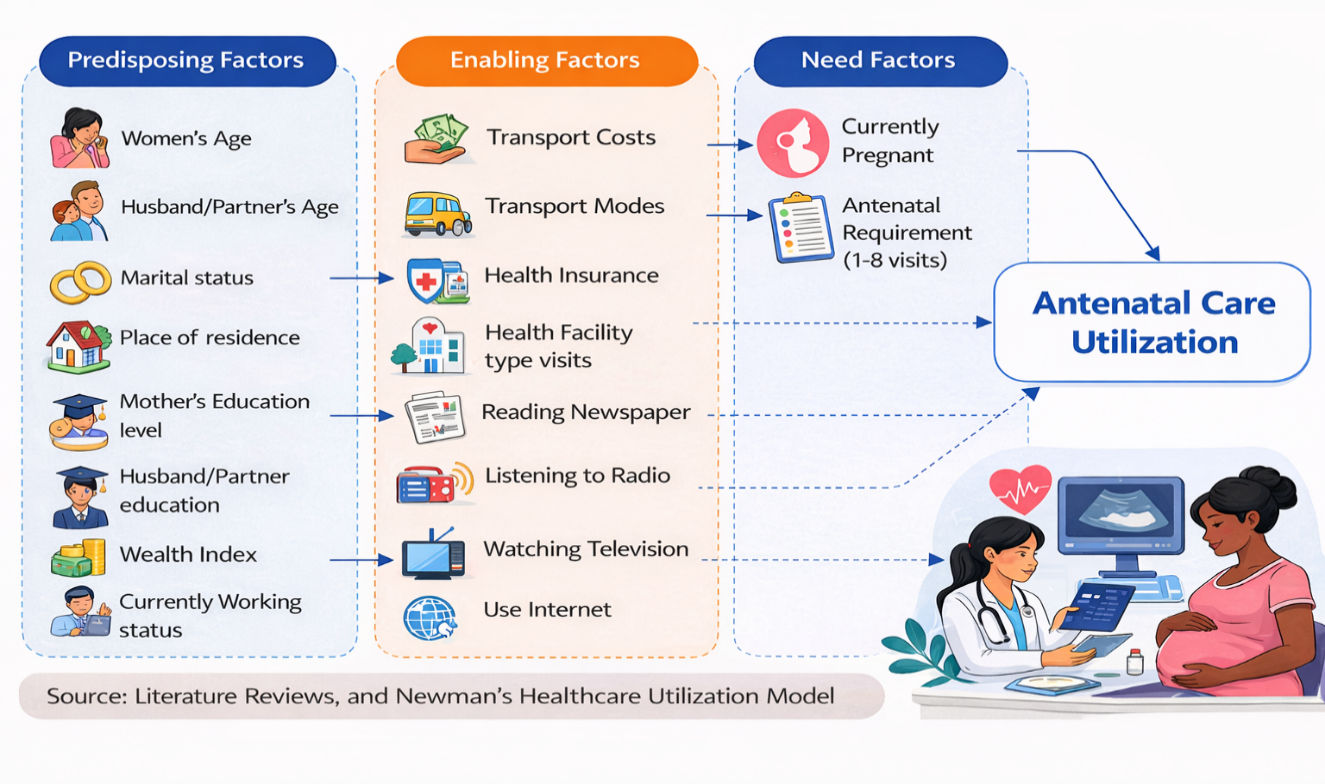
The Andersen and Newman Healthcare Utilization Model was initially developed by Ronald M. Andersen in 1968 and later refined in collaboration with James F. Newman in 1995 to explain the factors influencing individuals' use of healthcare services. The model was established to provide a comprehensive framework for understanding why some people seek healthcare while others do not, focusing on three key determinants: predisposing factors (demographic and social characteristics), enabling factors (financial and logistical resources), and need factors (perceived or actual health conditions) [4]. Predisposing factors refer to the demographic and social characteristics of women, such as education level, cultural beliefs, maternal age, and past pregnancy experiences, all which shape ANC utilization. For instance, educated women are more likely to recognize the importance of ANC and seek professional maternal healthcare services [8]. Conversely, cultural norms and traditional beliefs may deter some women from seeking institutional healthcare, especially in settings where traditional birth attendants (TBAs) are highly trusted [17]. Additionally, maternal age influences ANC attendance, as younger, less experienced mothers are less likely to seek care compared to older women who may have encountered pregnancy-related complications in the past [24].
Enabling factors play a crucial role in determining whether a woman can access ANC services, as they include financial and logistical resources such as income, healthcare facility availability, insurance coverage, and transportation. In many low- and middle-income countries (LMICs), financial barriers significantly hinder ANC utilization, particularly among low-income women who cannot afford medical fees or transportation to health facilities [21]. Wealthier households, in contrast, have the means to afford ANC visits, leading to higher attendance rates (Islam & Karim, 2021). Additionally, geographic distance to healthcare facilities remains a major obstacle in rural areas, where long travel distances and inadequate healthcare infrastructure prevent many women from receiving essential ANC services [2].
Need factors, which are the immediate determinants of healthcare utilization, refer to a woman’s perception of her health condition and pregnancy-related risk. Women who experience pregnancy complications such as gestational diabetes, hypertension, or severe anaemia are more likely to seek frequent ANC visits [8]. However, a lack of awareness about pregnancy risks can prevent some women from seeking timely ANC, particularly in settings where health literacy is low [17]. Previous pregnancy experiences also influence ANC behaviour, as women with difficult past pregnancies are more likely to complete the recommended ANC visits compared to those who have had uncomplicated births [24]. Given these factors, maternal healthcare policies should focus on increasing awareness of pregnancy-related risks, improving healthcare access, and removing financial barriers to ensure that all women, regardless of their socioeconomic background, can receive adequate ANC services. The Andersen and Newman model thus provides a structured approach to understanding the barriers and facilitators of ANC utilization, reinforcing its relevance in addressing maternal healthcare disparities.
Source: [4]
Empirical Literature Review
Several empirical studies have explored the determinants of antenatal healthcare utilization, offering valuable insights into the factors influencing maternal health-seeking behaviour. A study by Alibhai et al. (2022) conducted a systematic review across 37 fragile and conflict-affected settings, highlighting that security instability, financial constraints, and limited healthcare accessibility significantly reduce antenatal care (ANC) visits. Similarly, Dadi et al. (2021) examined rural Ethiopia’s maternity continuum of care, revealing that women who attended ANC frequently were more likely to deliver in health facilities and receive postnatal care. Another study by Selebano and Ataguba (2022) decomposed socio-economic inequalities in ANC utilization across 12 Southern African Development Community (SADC) countries, showing that wealth, education, and place of residence are key determinants influencing the use and intensity of ANC services. Further, Sabina Azhar, Islam and Karim (2021) investigated the prevalence of anaemia among pregnant women in Bangladesh and found that poor ANC attendance was strongly associated with maternal malnutrition and health complications. In contrast, Bhowmik, Biswas & Ananna (2020) used a modelling approach to analyse the number of ANC visits in Bangladesh and determined that lower educational levels, lack of autonomy, and rural residence contributed to reduced ANC attendance. Meanwhile, Pitsha, Chiruka & Marange (2025) applied Andersen’s behavioural model in Ethiopia, demonstrating that perceived severity of illness, healthcare system constraints, and lack of awareness-influenced women’s healthcare utilization choices. Additionally, Vouga et al. (2021) examined maternal outcomes during the COVID-19 pandemic and found that disruptions in healthcare services led to a sharp decline in ANC attendance, exacerbating maternal and neonatal risks. Moreover, Setonga, Chamwali & Mkuna (2024) studied ANC use in Lushoto District, Tanzania and found that ANC utilization was significantly determined by marital status, education, facility type, income, access to information, and waiting time for care. Despite the extensive research on antenatal healthcare utilization, most studies have been conducted at the district level, limiting their generalizability to broader populations. This study addresses this gap by examining ANC utilization determinants and its intensity at the national level using the recently updated TDHS-MIS 2022 dataset, offering a more comprehensive and policy-relevant analysis.
Conceptual Framework
Materials and Methods
This study used the 2022 Tanzania Demographic and Health Survey and Malaria Indicator Survey (2022 TDHS-MIS), a cross-sectional survey designed to provide nationally representative data on key population and health indicators in Tanzania. The 2022 TDHS-MIS aimed to generate reliable estimates on fertility, marriage, sexual activity, family planning, breastfeeding, nutrition, maternal and child mortality, maternal and child health, malaria prevalence, and other health-related issues. The survey specifically focused on women aged 15-49 years in a selected subsample, providing critical information for program managers and policymakers to evaluate and improve healthcare programs. A stratified two-stage cluster sampling design was employed to ensure national representativeness across urban and rural areas in Tanzania Mainland and Zanzibar. The first stage involved the selection of 629 enumeration areas (EAs) from the 2012 Tanzania Population and Housing Census (PHC), with 211 drawn from urban areas and 418 from rural areas, using probability proportional to size sampling. In the second stage, 26 households were systematically selected from each EA. Within these households, 15, 254 eligible women were identified, yielding a 97% response rate. Data collection was done through structured questionnaires adapted from The DHS Program’s Model Questionnaires, tailored to address Tanzania-specific health concerns. The 2022 TDHS-MIS provides crucial insights into maternal and child health, malaria control, and healthcare utilization in Tanzania.
Analytical Model
This study employed a Double-Hurdle Model to analyse the determinants and extent of antenatal healthcare utilization among Women of reproductive Age in maternal health facilities, Tanzania. The decision to seek for ANC service was modelled as a two-step decision process.
First Hurdle (Decision to Seek for ANC Service)
Firstly, it was whether these pregnant women decide to seek for ANC service or not. Let Ynx1 be binary outcome variable with categories 1 for pregnant women to seek for ANC service and O otherwise. Let denote the collection of predictor variables of Y and then the conditional probability that pregnant women decide to seek for ANC service is given as the Xi predictor variables which are denoted by. The probability that a pregnant women decide to seek for ANC services is assumed to be determined by the underlying response variable that explains their utilization. The underlying response variable, denoted by Y*, is expressed by the following regression equation:
the latent variable, that is the Utility a woman got when decide to seek for ANC, is the explanatory variable up to ith, and is the error term, assumed to be independent and normally distributed, such that and if and, if , the variable takes the value of 1 if pregnant women decide to seek for ANC and the marginal utility from a decision to seek for ANC is greater than a decision to not seek for ANCE and zero otherwise.
The double hurdle model integrates and concurrently estimates the Probit model to determine the probability of a decision to seek for ANC service and the truncated normal model for the extent to utilization (frequency of visit) [20].
To analyse the decision to seek for ANC service, the discrete and limited dependent variable model was used because the random preference is known and we can only predict the probability statements about the binary response on “yes” or “no”, therefore this study employed a Probit model to estimate the probability of a decision to seek for ANC service. The binary variable of the decision to seek for ANC service (C), as assumed to follow a Probit model, was specified as follows:
Where Pr is the probability, C is the binary variable of the decision to seek for ANC service, is the cumulative normal distribution, x is the vector of pregnant women socio-economic factors and are the coefficients to be estimated, and is the random error term distributed normally with zero mean and constant variance . If a pregnant women decide to seek for ANC, and otherwise. Mathematically, this is given as;
When, then implying the specific pregnant women decide to ANC service. This probability that a pregnancy women decide to seek for ANC service is estimated using Probit model below:
Where;
is the dependent variable (decision to seek for ANC) taking the value of 0 or 1; x is a set of explanatory variables such as age, education level, income, transport costs, healthcare insurance and occupation and β is the coefficient vector.
Therefore, the regression equation that incorporates all the identified factors above is as follows;
Second Hurdle Model (Extentto Visit/Frequency of Visit)
The Second Hurdle Model determines the extent to which pregnant women seek antenatal care (ANC) by measuring the number of ANC visits a woman makes to a healthcare facility. In this study, ANC utilization intensity is assessed through visit frequency, reflecting the depth of engagement with maternal healthcare services. The second hurdle corresponds to the Heckman Selection Model, which accounts for potential selection bias in healthcare-seeking behaviour. This model assumes that the error term follows a normal distribution with a constant standard deviation (homoscedasticity), ensuring consistency in estimations. The Heckman Model is particularly useful in correcting selection bias that may arise due to unobserved factors influencing ANC attendance, thereby providing more accurate and reliable estimates [7]. Unlike the Heckman sample selection models where women that do not seek for ANC are treated as missing observations in the second step [3]. The double hurdle model treats these women as corner solutions. The rationale for a corner solution model is that women not visiting ANC services are treated as valid and rational economic choices to be explained in the model and not a reflection of missing data [21].
Basing on the second stage model; the extent of ANC use (number visits) is as follow;
if and , If otherwise
Where; is an observed response to what extent pregnant women visit the healthcare facility, x is the set of pregnant women’s demographic and socio-economic factors, β is a vector of parameters and µi is the error term that is randomly distributed.
The empirical Heckman model is specified for this study as;
Where; is the number of visit and ith women decision to seek for ANC service, βi are parameters to be estimated and is an error term.
The Double Hurdle Model offers a distinct advantage over other estimation techniques by allowing separate sets of independent variables to influence a woman's decision to seek antenatal care (ANC) and the extent of ANC utilization. This model is particularly useful when analysing healthcare behaviours, as it recognizes that the decision to seek ANC and the number of visits made are influenced by different factors (Olawuyi & Hardman, 2019). Additionally, it is well suited for datasets obtained through probabilistic sampling methods, ensuring that the findings are generalizable and statistically robust ([13]; [28]). Compared to the Heckman Selection Model, the Double Hurdle Model provides greater flexibility by not imposing restrictions on the independent variables used in each stage of estimation, making it a more adaptable approach for understanding ANC utilization dynamics ([12]; [16]; [3]). This flexibility allows researchers to capture a broader range of socioeconomic and demographic influences, leading to more precise and policy-relevant insights into maternal healthcare-seeking behaviour.
Measurement of Variables
| Code | Variable | Measurement | Categories (Scale) | Expected sign |
| m14 | Number of antenatal visits | Count of ANC visits during pregnancy | Continuous | |
| v394 | ANC utilization | Whether the woman Visited a health facility for ANC | 0 = No visit, 1 = Visited | |
| v730 | Husband’s age | Age of husband in years | Continuous | + |
| v447a | Woman’s age | Age of woman in years | Continuous | |
| v106 | Woman education level | Highest educational attainment | 0 = No education, 1 = Primary, 2 = Secondary, 3 = Higher | + |
| v702 | Husband education level | Highest educational attainment of partner | 0 = No education, 1 = Primary, 2 = Secondary, 3 = Higher | + |
| v102 | Residence | Place of residence | 0 = Rural, 1 = Urban | + |
| v714 | Woman occupation | Employment status of respondent | 0 = Not working, 1 = Working | + |
| v704 | Husband occupation | Employment status of husband | 0 = Not working, 1 = Working | + |
| v190 | Wealth index | Household socioeconomic status | 1 = Poorest, 2 = Poorer, 3 = Middle, 4 = Richer, 5 = Richest | + |
| v157 | Reading newspapers | Frequency of reading newspapers or magazines | 0 = Not at all, 1 ≥ once/week | + |
| v158 | Listening to radio | Frequency of listening to radio | 0 = Not at all, 1 ≥ once/week | + |
| v159 | Watching television | Frequency of watching TV | 0 = Not at all, 1 ≥ once/week | + |
| v171a | Internet use | Access/use of internet | 0 = Never, 1 = Yes (last 12 months) | + |
| v481a | Community health insurance | Insurance through mutual/community schemes | 0 = No, 1 = Yes | + |
| v481b | Employer insurance | Insurance provided by employer | 0 = No, 1 = Yes | + |
| v481c | Social security insurance | Coverage through social security | 0 = No, 1 = Yes | + |
| v481d | Private insurance | Commercial/private insurance coverage | 0 = No, 1 = Yes | + |
| v483a | Distance to health facility | Travel time to nearest health facility (minutes) | Continuous | - |
| v483b | Mode of transport | Main transport to health facility | 1 = Walking, 2 = Car/Truck, 3 = Public Bus, 4 = Motorcycle/Bicycle | + |
| nf7 | Transport cost | Cost incurred when traveling to health facility | Continuous | + |
| m57f | Health facility type | Type of facility used for ANC | 0 = Private facility, 1 = Public facility | + |
Results
Descriptive Characteristics for the Study Variables
Table 2 presents the descriptive characteristics of the study population based on 40,394 observations, highlighting demographic, socioeconomic, information exposure, and healthcare access factors associated with antenatal care (ANC) utilization. Media exposure variables show statistically significant differences between women who utilized antenatal care (ANC) services and those who did not. The findings indicate that 81.40% of women who visited health facilities reported not reading newspapers or magazines compared to 80.07% among non-users, while 18.59% of ANC users read newspapers at least once a week compared to 19.92% among non-users, and the relationship remains statistically significant (χ² = 41.31, p < 0.01). This implies that newspaper exposure alone may not strongly motivate ANC utilization, possibly due to limited readership among women. In contrast, radio exposure shows a stronger association, as 55.81% of ANC users listen to the radio at least once a week compared to 50.30% among non-users (χ² = 133.27, p < 0.01), implying that radio remains an effective channel for disseminating maternal health information. Similarly, 39.18% of ANC users watch television weekly compared to 36.93% among non-users (χ² = 125.79, p < 0.01), suggesting that media exposure may improve awareness and encourage maternal healthcare utilization. Internet use remains relatively limited among the study population, although significant differences exist between women who utilized antenatal care (ANC) services and those who did not. The results show that 88.36% of women who visited health facilities reported never using the internet compared to 93.49% among non-users, while 11.63% of ANC users reported using the internet in the last 12 months compared to only 6.50% among non-users. The association between internet use and ANC utilization is statistically significant (χ² = 298.22, p < 0.01). This implies that women who have access to digital information platforms are more likely to utilize antenatal care services. These findings suggest that exposure to information through mass media and digital channels plays a significant role in shaping maternal healthcare awareness and healthcare-seeking behaviour.
The socioeconomic characteristics of respondents also reveal important differences in ANC utilization. Educational attainment of women shows a strong association with healthcare use. Among women who visited health facilities, 20.86% had secondary education compared to only 11.51% among non-users, and this difference is highly significant (χ² = 766.86, p < 0.01). Similarly, husbands’ education levels influence ANC utilization; women whose partners had secondary education were more likely to visit health facilities (20.49%) compared to those whose partners had no formal education (30.70% among users versus 37.86% among non-users), and this association is statistically significant (χ² = 533.24, p < 0.01). Household wealth also demonstrates a strong relationship with maternal healthcare use. Women in the richest wealth quintile account for 20.52% of ANC users compared to only 15.06% among non-users, while those in the poorest category represent 17.55% of users and 22.22% of non-users (χ² = 284.94, p < 0.01). Employment status further reveals disparities in healthcare access. About 70.74% of women who utilized ANC services were employed compared to 64.82% among non-users (χ² = 158.14, p < 0.01), while 74.24% of husbands of ANC users were employed compared to 62.90% among non-users (χ² = 593.14, p < 0.01). These results indicate that education, wealth status, and employment significantly influence maternal health-seeking behaviour.
| Variable | Category | Did Not Visit Health Facility n (%) | Visited Health Facility n (%) | χ² value |
| Women Education | No education | 1843 (29.55) | 1963 (21.77) | 766.86*** |
| Primary | 3650 (58.51) | 5094 (56.53) | ||
| Secondary | 718 (11.51) | 1881 (20.86) | ||
| Higher | 27 (0.44) | 75 (0.83) | ||
| Husband Education | No formal education | 2362 (37.86) | 2767 (30.70) | 533.24*** |
| Primary education | 2733 (43.79) | 3762 (41.74) | ||
| Secondary education | 912 (14.62) | 1847 (20.49) | ||
| Higher education | 233 (3.73) | 637 (7.06) | ||
| Wealth Index | Poorest | 1386 (22.22) | 1582 (17.55) | 284.94*** |
| Poorer | 1311 (21.02) | 1739 (19.29) | ||
| Middle | 1375 (22.05) | 2021 (22.41) | ||
| Richer | 1227 (19.66) | 1822 (20.22) | ||
| Richest | 941 (15.06) | 1850 (20.52) | ||
| Mode of Transport | Walking | 4973 (79.71) | 7410 (82.19) | 146.60*** |
| Car/Truck | 550 (8.81) | 789 (8.75) | ||
| Public Bus | 176 (2.82) | 307 (3.41) | ||
| Motorcycle/Bicycle | 541 (8.66) | 508 (5.65) | ||
| Place of Residence | Urban | 1638 (26.25) | 2584 (28.67) | 28.55*** |
| Rural | 4602 (73.75) | 6430 (71.33) | ||
| Women Occupation | Not working | 2196 (35.18) | 2637 (29.26) | 158.14*** |
| Working | 4044 (64.82) | 6377 (70.74) | ||
| Husband Occupation | Not working | 2315 (37.10) | 2322 (25.76) | 593.14*** |
| Working | 3925 (62.90) | 6692 (74.24) | ||
| Reading Newspaper | Not at all | 4997 (80.07) | 7339 (81.40) | 41.31*** |
| /Magazine | At least once/week | 1243 (19.92) | 1675 (18.59) | |
| Listening to Radio | Not at all | 3099 (49.69) | 3984 (44.18) | 133.27*** |
| At least once/week | 3141 (50.30) | 5030 (55.81) | ||
| Watching Television | Not at all | 3935 (63.06) | 5481 (60.81) | 125.79*** |
| At least once/week | 2305 (36.93) | 3533 (39.18) | ||
| Internet Use | Never | 5,833 (93.49) | 7966 (88.36) | 298.22*** |
| Yes, last 12 months | 407 (6.5) | 1048 (11.63) | ||
| Community Insurance | No | 6128 (98.24) | 8854 (98.22) | 0.03 |
| Yes | 112 (1.76) | 160 (1.78) | ||
| Employer Insurance | No | 6089 (97.62) | 8695 (96.47) | 43.88*** |
| Yes | 151 (2.38) | 319 (3.53) | ||
| Social Security Insurance | No | 6234 (99.90) | 9003 (99.87) | 1.13 |
| Private Facility | 6 (0.10) | 11 (0.13) | ||
| Health Facility Type | Public Facility | 6237 (99.95) | 8997 (99.81) | 13.70*** |
| Private Facility | 3 (0.05) | 17(0.19) | ||
| Variable description | Visited health facility [Mean (SD)] | Not visited[Mean (SD)] | Total Mean (SD) | t-value |
| Husband/Partner Age (years) | 42.54 (9.23) | 44.40 (9.47) | 43.30 (9.38) | 19.72*** |
| Woman’s Age (years) | 17.53 (18.55) | 18.77 (19.62) | 18.04 (19.01) | 6.43*** |
| Distance to Health Facility (minutes) | 39.96 (45.73) | 40.64 (50.44) | 40.24 (47.71) | 1.41 |
| Transport Cost | 1.36 (3.46) | 0.96 (2.97) | 1.19 (3.28) | -11.97*** |
| Number of ANC Visits | 4.42 (2.76) | 4.30 (1.64) | 4.37 (2.37) | -4.84*** |
Source: Author’s Computations from TDHS-MIS (2022)
Healthcare accessibility and infrastructure factors also demonstrate significant associations with ANC utilization. Transportation mode differs significantly between users and non-users of ANC services (χ² = 146.60, p < 0.01). A large proportion of women who visited health facilities reported walking to healthcare centres (82.19%) compared to 79.71% among non-users, while the use of motorcycles or bicycles was more common among non-users (8.66%) than among users (5.65%). Place of residence also shows a statistically significant difference (χ² = 28.55, p < 0.01), with 28.67% of ANC users living in urban areas compared to 26.25% among non-users. Health insurance coverage remains generally low across the population. Community-based insurance shows no significant association with ANC utilization (χ² = 0.03, p > 0.05), and social security insurance shows no statistically significant difference (χ² = 1.13, p > 0.05). However, employer-based insurance demonstrates a significant relationship with ANC utilization, with 3.53% of ANC users covered compared to 2.38% among non-users (χ² = 43.88, p < 0.01). Additionally, the type of health facility attended differs significantly across groups, as 99.81% of ANC users accessed services from public facilities compared to 99.95% among non-users who reported no facility-based care (χ² = 13.70, p < 0.01). These findings suggest the role of healthcare accessibility and institutional support in shaping maternal health service utilization, indicating that when healthcare services are physically reachable and supported by functional health systems, women are more likely to seek and utilize antenatal care services.
The continuous variables further provide insights into demographic and access-related conditions affecting ANC use. The mean age of husbands among women who visited health facilities is 42.54 years compared to 44.40 years among those who did not visit facilities, and the difference is statistically significant (t = 19.72, p < 0.01). Similarly, women who utilized ANC services are slightly younger on average (17.53 years) compared to non-users (18.77 years), and this difference is statistically significant (t = 6.43, p < 0.01). Distance to the nearest health facility does not differ significantly between the two groups, as women who visited facilities reported an average travel time of 39.96 minutes compared to 40.64 minutes among non-users (t = 1.41, p > 0.05). Transport costs, however, are significantly higher among women who utilized ANC services, with an average cost of 1.36 compared to 0.96 among non-users (t = −11.97, p < 0.01). Finally, the mean number of antenatal visits is slightly higher among women who visited health facilities (4.42 visits) compared to those who did not (4.30 visits), and this difference is statistically significant (t = −4.84, p < 0.01). Despite this, the average number of visits (4.37) remains below the World Health Organization recommendation of at least eight antenatal contacts during pregnancy, indicating that many women in the study population are receiving the full continuum of recommended maternal healthcare services.
Determinants and Extent of Antenatal Care Utilization among Women of Reproductive Age
Table 3 presents the determinants of antenatal care (ANC) utilization and the frequency of ANC visits among women of reproductive age using a two-tier estimation approach. The first tier measures the probability of utilizing ANC services, while the second tier captures the intensity of utilization measured by the number of visits. The results indicate that some demographic characteristics significantly influence ANC utilization. For instance, the age of the husband or partner shows a positive and statistically significant effect on ANC utilization (β = 0.0251, p < 0.01). This implies that a one-year increase in the husband’s age increases the likelihood of antenatal care utilization by approximately 2.5%, suggesting that older partners may provide greater support or decision-making capacity regarding maternal health services. However, in Tier 2 the husband’s age has a negative and statistically significant effect (β = −0.0068, p < 0.01), indicating that a one-year increase in husband’s age reduces the frequency of ANC visits by about 0.68%. Additionally, husband’s higher education shows a positive and significant association with ANC utilization (β = 0.214, p < 0.05), meaning that women whose partners have higher education are about 21.4% more likely to utilize antenatal care services compared to those whose partners have no formal education. In the second tier, women’s secondary education significantly increases the number of ANC visits (β = 0.1873, p < 0.05), indicating that women with secondary education make about 18.7% more antenatal visits compared to women without formal education.
Socioeconomic characteristics also play an important role in influencing antenatal care utilization. The results show that women’s employment status significantly increases the likelihood of ANC utilization (β = 0.4405, p < 0.01). This suggests that employed women are about 44% more likely to utilize antenatal care services than those who are not working, possibly due to improved financial autonomy and health awareness. Similarly, husband employment status has a positive and statistically significant effect on the frequency of ANC visits (β = 0.07350, p < 0.01), indicating that women whose husbands are employed make about 7.3% more ANC visits compared to those whose husbands are not employed. Household wealth also significantly influences ANC utilization. Compared with women in the poorest households, women in the poorer wealth category are 10.5% more likely to utilize ANC services (β = 0.10515, p < 0.05), while those in the middle wealth group are 17.6% more likely to use ANC services (β = 0.1763, p < 0.01). Women from richer households are 27.2% more likely to utilize ANC services (β = 0.2721, p < 0.01), and those in the richest households are 19.1% more likely to utilize ANC services (β = 0.19095, p < 0.05). Wealth also increases the frequency of visits; for example, women in richer households make about 8.9% more ANC visits (β = 0.0885, p < 0.05), while those in the richest households make approximately 25.8% more visits (β = 0.2576, p < 0.01).
| First Hurdle (Tier 1) | Second Hurdle (Tier 2) | |||||
| Variables | Coef. | Std. Err. | P-value | Coef. | Std. Err. | P-value |
| Women’s Age | -0.0001 | 0.0009 | 0.922 | -0.0006 | 0.0006 | 0.281 |
| Husband Age | 0.0251*** | 0.0023 | 0.000 | -0.0068*** | 0.0019 | 0.001 |
| Marital Status (Married) | 0.0276 | 0.0715 | 0.700 | 0.0260 | 0.0441 | 0.555 |
| Women Education | ||||||
| Women Primary Education | -0.0059 | 0.0415 | 0.885 | 0.0110 | 0.0278 | 0.691 |
| Women Secondary Education | 0.0341 | 0.0629 | 0.588 | 0.1873** | 0.0730 | 0.010 |
| Women Higher Education | 0.1566 | 0.2758 | 0.570 | 0.6043 | 0.3769 | 0.109 |
| Husband Education | ||||||
| Husband Primary Education | -0.0427 | 0.0498 | 0.391 | -0.0023 | 0.0433 | 0.957 |
| Husband Secondary Education | 0.0840 | 0.0619 | 0.175 | -0.0363 | 0.0601 | 0.545 |
| Husband Higher Education | 0.2140** | 0.0997 | 0.032 | -0.1059 | 0.0665 | 0.111 |
| Husband Occupation (Employed) | 0.0516 | 0.0482 | 0.285 | 0.0735*** | 0.0283 | 0.010 |
| Women Occupation (Employed) | 0.4405*** | 0.0354 | 0.000 | -0.0229 | 0.0366 | 0.531 |
| Distance nearest to Health Facility | 0.0008** | 0.0003 | 0.015 | -0.0001 | 0.0002 | 0.515 |
| Wealth Index | ||||||
| Poorer Wealth Index | 0.1051** | 0.0486 | 0.031 | 0.0839** | 0.0415 | 0.043 |
| Middle Wealth Index | 0.1763*** | 0.0519 | 0.001 | 0.0502 | 0.0309 | 0.105 |
| Richer Wealth Index | 0.2721*** | 0.0650 | 0.000 | 0.0885** | 0.0450 | 0.049 |
| Richest Wealth Index | 0.1909** | 0.0883 | 0.031 | 0.2576*** | 0.0994 | 0.010 |
| Urban Residence | -0.0347 | 0.0514 | 0.499 | 0.0094 | 0.0446 | 0.832 |
| Health Insurance | ||||||
| Mutual/Community Insurance | 0.2699 | 0.1868 | 0.148 | 0.0079 | 0.0243 | 0.743 |
| Employer Insurance | -0.3067*** | 0.1055 | 0.004 | -0.0286 | 0.1158 | 0.805 |
| Social Security Insurance | 3.0581*** | 0.0895 | 0.000 | -0.1611 | 0.1163 | 0.166 |
| Transport Cost | 0.0058 | 0.0057 | 0.306 | 0.0031 | 0.0041 | 0.445 |
| Transport Modes | ||||||
| Walking | 0.2897*** | 0.0518 | 0.000 | 0.0367 | 0.0501 | 0.463 |
| Car/Truck | 0.1925*** | 0.0731 | 0.009 | 0.1624* | 0.0941 | 0.084 |
| Public Bus | 0.5966*** | 0.1468 | 0.000 | 0.1892 | 0.1532 | 0.217 |
| Public Health Facility | -3.4429*** | 0.0863 | 0.000 | -5.7633** | 2.9047 | 0.047 |
| Reading Newspaper | -0.1348*** | 0.0307 | 0.000 | 0.02461 | 0.0309 | 0.427 |
| Listening to Radio | 0.0771*** | 0.0225 | 0.001 | -0.0244 | 0.0204 | 0.233 |
| Watching Television | -0.0065 | 0.0270 | 0.808 | -0.0009 | 0.0250 | 0.969 |
| Use Internet | 0.1030 | 0.0741 | 0.165 | 0.0431 | 0.0629 | 0.493 |
| Constant | 3.8286 | 0.1251 | 0.000 | 10.0001 | 2.8360 | 0.000 |
| Sigma | 2.5790 | 0.3773 | 0.000 | |||
| Number of Observations | 15, 254 | |||||
| Wald Chi2(29) | 5436.54 | |||||
| Prob>Chi2 | 0.0000 | |||||
| Loglikelihood (double hurdle) | -91073.056 |
Source: Author’s Computations from TDHS-MIS (2022)
Table 3 further shows that health system access factors also significantly affect antenatal care utilization. The distance to the nearest health facility shows a positive and statistically significant effect on ANC utilization (β = 0.0008, p < 0.05), implying that an increase in distance slightly increases the likelihood of seeking ANC services by 0.086%. Although the effect size is small, it indicates that women who travel longer distances may be seeking care in facilities perceived to offer better services. Transportation mode also plays an important role. Women who walk to health facilities are about 28.9% more likely to utilize ANC services (β = 0.2897, p < 0.01) compared with the reference group. Similarly, women who travel using cars or trucks are 19.3% more likely to utilize ANC services (β = 0.1925, p < 0.01), while those using public buses are 59.7% more likely to utilize ANC services (β = 0.59668, p < 0.01). Additionally, transportation using cars or trucks slightly increases the number of ANC visits by about 16.2% (β = 0.1624, p < 0.10). Health insurance coverage also contributes to improved utilization. Women covered by employer-provided insurance are about 30.7% more likely to utilize ANC services (β = 0.3067, p < 0.01), while those covered by social security health insurance are over three times more likely (approximately 305.8%) to utilize ANC services (β = 3.0581, p < 0.01) compared with women without such coverage.
Information and communication variables show mixed effects on ANC utilization. Reading newspapers has a negative and statistically significant association with ANC utilization (β = −0.1348, p < 0.01), implying that women who read newspapers are about 13.5% less likely to utilize ANC services compared to those who do not read newspapers. In contrast, listening to the radio significantly increases ANC utilization (β = 0.0771, p < 0.01), meaning that women who listen to the radio are about 7.7% more likely to utilize antenatal care services. Radio therefore appears to be an effective communication channel for promoting maternal health awareness. Other information channels such as watching television and internet use do not show statistically significant effects in this model. Finally, visiting public health facilities has a strong negative and significant relationship with both ANC utilization (β = −3.4429, p < 0.01) and the frequency of visits (β = −5.7633, p < 0.05). This implies that relying on public health facilities reduces the likelihood of ANC utilization by about 344% and reduces the frequency of visits by approximately 576%, which may reflect capacity constraints, overcrowding, or quality challenges within public health facilities. Overall, these findings strongly support the Andersen and Newman Behavioural Model of Health Service Utilization, showing that predisposing factors (education, age, information exposure), enabling factors (wealth, employment, insurance, transportation, and healthcare accessibility), and health system conditions jointly determine antenatal care utilization and the intensity of ANC visits.
Discussions
Husband’s age significantly influences antenatal care (ANC) utilization across both tiers of the hurdle model. Husband’s age positively increases the probability that women initiate ANC services, suggesting that older partners may have greater awareness of pregnancy risks and therefore encourage early healthcare seeking. However, husband’s age negatively affects the frequency of ANC visits, implying that while older partners may support initial contact with health services, they may not necessarily encourage repeated visits throughout pregnancy. Within Andersen and Newman’s Behavioural Model, husband’s age represents a predisposing factor that shapes household health attitudes and decision-making. These findings align with Dadi et al. (2021), who identified household socio-demographic characteristics, including partner characteristics, as significant determinants influencing women’s progression through the maternity care continuum, including antenatal care attendance. Similarly, Selebano and Ataguba (2022) reported that demographic characteristics of households, such as age and family composition, significantly influence maternal healthcare utilization patterns across Southern African Development Community countries. Bhowmik, Biswas and Ananna (2020) also highlighted that household demographic characteristics play an important role in maternal healthcare-seeking behaviour because family members often influence decisions regarding antenatal visits. In Tanzania, Anasel et al. (2024) also noted that household demographic and socioeconomic characteristics interact to influence maternal healthcare utilization decisions.
Women with secondary education significantly increase the frequency of ANC visits, although education does not significantly influence the initial decision to seek ANC. This suggests that education does not necessarily determine whether women initiate ANC but plays a stronger role in ensuring continuity and adherence to recommended visits once healthcare contact has been established. In Andersen’s Behavioural Model, education is categorized as a predisposing factor because it influences health knowledge and attitudes toward healthcare services. These findings align with Bhowmik, Biswas and Ananna (2020), who found that women’s education significantly increases the number of antenatal visits because educated women have better knowledge of pregnancy risks and healthcare benefits. Similarly, Dadi et al. (2021) reported that maternal education significantly improves continuation along the maternity care continuum, including antenatal care attendance, institutional delivery, and postnatal care. Selebano and Ataguba (2022) also identified education as one of the key determinants of ANC utilization across SADC countries, demonstrating that women with higher education are more likely to utilize maternal healthcare services. In Tanzania, Anasel et al. (2024) and Kubetta, [20] further emphasized that education improves women’s ability to navigate healthcare systems and utilize maternal health services, particularly when combined with financial support mechanisms such as health insurance.
Husband’s higher education significantly increases the probability of ANC utilization, suggesting that educated partners play an important role in encouraging women to initiate antenatal care. Within Andersen’s Behavioural Model, partner education represents a predisposing social factor because it shapes household knowledge and attitudes toward healthcare utilization. These findings align with Selebano and Ataguba (2022), who identified education within households, including partner education, as a key determinant of maternal healthcare utilization across Southern African countries. Similarly, Bhowmik, Biswas and Ananna (2020) reported that household education levels, including partner education, significantly improve maternal healthcare utilization because educated family members had better understand the importance of antenatal services. Dadi et al. (2021) also found that women whose partners have higher educational attainment are more likely to initiate antenatal care and continue maternal healthcare services. In Tanzania, Anasel et al. (2024) observed that education within households enhances understanding of healthcare benefits, thereby improving maternal healthcare utilization.
Husband’s employment significantly increases the frequency of ANC visits, although it does not significantly influence the initial decision to seek ANC. This indicates that financial stability primarily affects the ability of households to maintain repeated healthcare visits once ANC has been initiated. Within Andersen’s Behavioural Model, employment is categorized as an enabling factor because it provides financial resources required to access healthcare services. These findings align with Selebano and Ataguba (2022), who identified household income and employment status as important determinants of maternal healthcare utilization across Southern African countries. Similarly, Bhowmik, Biswas and Ananna (2020) found that household income and economic stability significantly increase the number of antenatal visits, as women from financially stable households are better able to afford transportation and healthcare costs. Dadi et al. (2021) also reported that economic resources facilitate continuation along the maternity care continuum by reducing financial barriers to healthcare utilization. In Tanzania, Anasel et al. (2024) similarly found that economic capacity and financial protection mechanisms significantly increase maternal healthcare utilization.
Women’s employment significantly increases the probability of ANC utilization, but it does not significantly influence the number of visits. This suggests that women’s economic independence plays a stronger role in initiating healthcare seeking rather than determining how frequently services are utilized. Within Andersen’s Behavioural Model, women’s employment represents an enabling factor because it improves financial independence and decision-making power. These findings align with Bhowmik, Biswas and Ananna (2020), who reported that women’s employment significantly increases the likelihood of attending antenatal visits, largely due to improved financial autonomy and decision-making capacity. Similarly, Selebano and Ataguba (2022) identified women’s economic empowerment and employment status as key determinants of maternal healthcare utilization across Southern African countries. Dadi et al. (2021) also found that financial empowerment improves women’s ability to initiate maternal healthcare services. In Tanzania, Anasel et al. (2024) similarly reported that women’s economic empowerment significantly improves access to maternal healthcare services.
Distance to the nearest health facility significantly influences ANC initiation in Tier 1, but it does not significantly affect the frequency of visits in Tier 2. This suggests that geographical accessibility primarily determines whether women seek care at all, rather than how frequently they attend once healthcare contact has been established. Within Andersen’s Behavioural Model, distance is considered a health system-enabling factor because it determines the physical accessibility of healthcare services. These findings align with Dadi et al. (2021), who identified distance to health facilities as a major determinant influencing whether women initiate antenatal care services. Similarly, Selebano and Ataguba (2022) reported that geographical accessibility to healthcare facilities significantly affects maternal healthcare utilization across Southern African countries. Bhowmik, Biswas and Ananna (2020) also found that long travel distances significantly reduce antenatal care attendance due to increased transportation costs and travel time. In Tanzania, Anasel et al. (2024) similarly reported that geographical accessibility remains a key determinant of maternal healthcare utilization.
Household wealth significantly increases both the probability of ANC utilization (Tier 1) and the frequency of visits (Tier 2), indicating that economic resources influence both healthcare initiation and continued use. Within Andersen’s Behavioural Model, wealth represents an enabling factor because it reflects the financial capacity required to access healthcare services. These findings align with Selebano and Ataguba (2022), who identified household wealth index as a key determinant of maternal healthcare utilization across SADC countries, with wealthier households demonstrating significantly higher ANC use. Similarly, Bhowmik, Biswas and Ananna (2020) found that household wealth significantly increases the number of antenatal visits, as women from wealthier households are more able to afford healthcare-related costs. Dadi et al. (2021) also reported that wealth significantly improves women’s progression along the maternity care continuum. In Tanzania, Anasel et al. (2024) found that financial protection mechanisms and economic capacity significantly increase maternal healthcare utilization.
Health insurance shows mixed effects across the two tiers. Social security insurance significantly increases ANC utilization, while employer insurance shows a negative association with ANC initiation, and neither significantly influences the frequency of visits. These findings indicate that insurance schemes influence whether women seek care initially, but they may not necessarily affect continued utilization. Within Andersen’s Behavioural Model, health insurance is an enabling factor that reduces financial barriers to healthcare services. These findings strongly align with Anasel et al. (2024), who found that health insurance significantly increases maternal healthcare utilization in Tanzania by reducing out-of-pocket healthcare costs and improving access to services. Similarly, Selebano and Ataguba (2022) reported that financial protection mechanisms significantly improve maternal healthcare utilization across Southern African countries. Dadi et al. (2021) also identified financial barriers as a key determinant of maternal healthcare utilization, while Bhowmik, Biswas and Ananna (2020) highlighted that financial constraints significantly reduce antenatal care attendance among poorer households.
Transport modes significantly influence ANC initiation, with walking, car/truck, and public bus transport increasing the likelihood of seeking antenatal care. However, these variables do not significantly influence the frequency of visits, indicating that transportation primarily affects initial healthcare access rather than repeated visits. Within Andersen’s Behavioural Model, transportation represents a health system-enabling factor because it determines the physical accessibility of healthcare services. These findings align with Dadi et al. (2021), who identified transportation and accessibility barriers as key determinants of maternal healthcare utilization. Similarly, Selebano and Ataguba (2022) reported that infrastructure and accessibility significantly influence maternal healthcare utilization across Southern African countries. Bhowmik, Biswas and Ananna (2020) also found that transportation challenges significantly reduce antenatal care attendance. In Tanzania, Anasel et al. (2024) reported that improved accessibility and financial protection mechanisms significantly increase maternal healthcare utilization.
Reliance on public health facilities shows a negative and significant effect in both Tier 1 and Tier 2, suggesting that women who depend on public facilities are less likely to initiate ANC and less likely to attend multiple visits. This may reflect systemic challenges such as overcrowding, long waiting times, and resource constraints within public healthcare systems. These findings align with Dadi et al. (2021), who reported that health system constraints could limit maternal healthcare utilization even when services are available. Similarly, Selebano and Ataguba (2022) observed that health system inequalities and infrastructure limitations significantly affect maternal healthcare utilization across Southern African countries. Bhowmik, Biswas and Ananna (2020) also reported that health system barriers reduce antenatal care attendance, while Anasel et al. (2024) noted that health system limitations could influence women’s decisions to seek maternal healthcare services in Tanzania.
Media exposure significantly increases ANC initiation. This suggests that access to information plays a stronger role in encouraging women to seek healthcare initially rather than determining the continuity of visits. Within Andersen’s Behavioural Model, media exposure is categorized as a predisposing factor because it shapes health knowledge and attitudes. These findings align with Dadi et al. (2021), who found that exposure to maternal health information significantly increases antenatal care attendance. Similarly, Bhowmik, Biswas and Ananna (2020) reported that access to health information significantly improves women’s awareness of pregnancy risks and healthcare services. Selebano and Ataguba (2022) also identified information access and awareness as important determinants of maternal healthcare utilization, while Anasel et al. (2024) reported that awareness and health information access significantly improve maternal healthcare utilization in Tanzania.
Conclusion
The findings from this study highlight that antenatal care (ANC) utilization and visit frequency among women of reproductive age in Tanzania are significantly influenced by socioeconomic, educational, employment, geographical and healthcare access factors. Women with higher education and employment status are more likely to seek ANC services, while financial constraints, public healthcare inefficiencies, and transportation barriers negatively affect utilization. Additionally, husbands' education and employment status play a supporting role in influencing maternal healthcare decisions. The study also reveals that urban women tend to visit ANC facilities less frequently, possibly due to work commitments and healthcare accessibility concerns. Improving access to quality maternal healthcare services, reducing bureaucratic delays, and increasing awareness of ANC benefits can significantly enhance maternal health outcomes. Addressing barriers related to education, employment, transport, and public healthcare service quality will ensure that more women receive adequate antenatal care, ultimately reducing maternal and child health risks.
Policy Implications
The results provide important insights for strengthening maternal health policies and programs in Tanzania. Increasing ANC utilization requires policies that simultaneously address financial, geographic, and informational and health system barriers. Expanding health insurance coverage through schemes such as the National Health Insurance Fund (NHIF) and community-based health insurance programs can reduce financial constraints and encourage more women to access maternal healthcare services. Strengthening primary healthcare facilities under the Primary Health Care Development Program and the Health Sector Strategic Plan (HSSP) is also critical to improve service quality and reduce congestion in public facilities. Furthermore, improving transport infrastructure and maternity outreach services, particularly in rural areas, can reduce distance and travel barriers that limit ANC attendance. Public health communication strategies should prioritize radio-based maternal health campaigns, which have proven effective in increasing ANC utilization, while also expanding digital and community health education programs. Finally, integrating these strategies within Tanzania’s broader Universal Health Coverage (UHC) agenda and the National Road Map Strategic Plan for Maternal, Newborn and Child Health will be essential for improving maternal health outcomes and ensuring that women complete the recommended number of antenatal visits during pregnancy.
Competing interest
The authors declares that there are no competing interests associated with this manuscript.
Funding
No funding was received for this work.
Data availability
The data that support the findings of this study are available from the corresponding author upon reasonable request or on visits at National Bureau of Statistics (https://microdata.nbs.go.tz/index.php/catalog/38).
References
- Addisu, D., Mekie, M., Melkie, A., Abie, H., Dagnew, E., Bezie, M., ... & Chanie, E. S. (2022). Continuum of Maternal Healthcare Services Utilization and Its Associated Factors in Ethiopia: A Systematic Review and meta-Analysis. Women's Health, 18, DOI: 10.1177/17455057221091732
- Alibhai, K. M., Ziegler, B. R., Meddings, L., & Batung, E. (2022). Factors Impacting Antenatal Care Utilization: A Systematic Review of 37 Fragile and Conflict-Affected Situations. Springer. DOI: 10.1186/s13031-022-00459-9
- Anasel, M. G., Komba, C., Kacholi, G., Genda, E. L., Chamwali, L., Mwakasangula, E. & Kitole, F. A. (2024). The Effects of Health Insurance on Maternal Healthcare Utilization in Tanzania. Global Social Welfare, 11(4), 343-357. DOI: 10.1007/s40609-024-00345-7
- Andersen, R. M. (1995). Revisiting the behavioral model and access to medical care: Does it matter? Journal of Health and Social Behavior, 36(1), 1–10. DOI: 10.2307/2137284
- Andersen, R., & Newman, J. F. (1973). Societal and Individual Determinants of Medical Care Utilization in the United States. The Milbank Memorial Fund Quarterly. Health and Society, 51, 95-124. DOI: 10.2307/3349613
- Bhowmik, J., Biswas, R. K., & Ananna, N. (2020). Women’s Education and Coverage of Skilled Birth Attendance: An assessment of Sustainable Development Goal 3.1 in the South and Southeast Asian Region. PloS one, 15(4), e0231489. DOI: 10.1371/journal.pone.0231489
- DOI: 10.1177/1536867X251322971
- Dadi, T. L., Medhin, G., Kasaye, H. K., & Kassie, G. M. (2021). Continuum of Maternity Care Among Rural Women in Ethiopia: Does Place and Frequency of Antenatal Care Visit Matter? Reproductive Health, Springer. DOI: 10.1186/s12978-021-01265-x
- Esther, A. Q., Yahaya, H., Esther, A. O., Aboagye-Mensah, P., Blessing, A. J., & Ikome, T. E. (2024). A Scoping Review on Influence of Socioeconomic Status on Antenatal Care Utilization and Pregnancy Outcomes in Sub-Saharan Africa. MedRxiv, 2024-01. DOI: 10.1101/2024.01.11.24301063
- Grossman, M. (1972). On the concept of health capital and the demand for health. Journal of Political Economy, 80(2), 223–255. DOI: 10.1086/259880
- Grossman, M. (2022). The Demand for Health Turns 50: Reflections. Health Economics, 31(9), 1807-1822. DOI: 10.1002/hec.4563
- Heckman, J. J. (1979). Sample selection bias as a specification error. Econometrica, 47(1), 153–161. DOI: 10.2307/1912352
- Jones, A. M. (2020). Health Econometrics: An introduction. Oxford University Press. DOI: 10.1093/gmo/9781561592630.article.20622
- Kubetta, N. E., Omary, P. S. & Mugula, V. J. (2024). The Effects of Health Insurance on Demand for Healthcare Services in Tanzania. Social Science and Humanities Journal. Volume 08 (10). DOI: DOI: 10.18535/sshj.v8i10.1344
- Lee, S., Kasibante, S., Eminai, A., Wani, S., Opii, D. J., Levine, L. D., & Kanyike, A. M. (2025). Effectiveness of a Community Health Worker-Led Education Intervention on Knowledge, Attitude, and Antenatal Care Attendance among Pregnant Women in Eastern Uganda. Journal of Health, Population and Nutrition, 44(1), 232. Doi: . DOI: 10.1186/s41043-025-00876-5
- Moffatt, P. G. (2019). Econometrics of Health Behaviours: Theory and Applications. Cambridge University Press. DOI: 10.1111/1475-4932.12741
- Mohamed, S. O. O., & Ahmed, E. M. (2022). Prevalence and determinants of antenatal tetanus vaccination in Sudan: A cross-sectional analysis of the Multiple Indicator Cluster Survey. Springer. Https://Link.Springer.Com/Article/ DOI: 10.1186/S41182-022-00398-4
- National Bureau of Statistics (NBS) (2022). Tanzania Demographic and Health Survey and Malaria Indicator Survey 2022. NBS and ICF. Https://Dhsprogram.Com/ DOI: 10.3389/ijph.2025.1608146
- Oladeji, B. D., Bello, T., Ayinde, O., & Idowu, P. (2022). Prevalence and Correlates of Depression among Pregnant Adolescents in Primary Maternal Care in Nigeria. Springer. Https://Link.Springer.Com/Article/ DOI: 10.1007/S00737-021-01198-1
- Omary, P. S. and Shitima, C. M. (2026) Socio-Economic Analysis of Smallholder Water User’s Participation on Water Resources Management in Tanzania: A Double Hurdle Analysis. Open Access Library Journal, 13, 1-20. Doi: . DOI: 10.4236/oalib.1113365
- DOI: 10.3390/Mca30050095
- DOI: 10.1371/Journal.Pone.0266185
- Sabina Azhar B, Islam MS, Karim MR. (2021) Prevalence of anemia and associated risk factors among pregnant women attending antenatal care in Bangladesh: a cross-sectional study. Primary Health Care Research & Development 22(e61): 1–10. doi: . DOI: 10.1017/S146342362100061X
- DOI: 10.1016/J.Ssmph.2021.101004
- Setonga, J., Chamwali, L., & Mkuna, E. (2024). Overcoming Barriers, Embracing Opportunities: Antenatal Care Use in Lushoto, Tanzania. eajahme, 7(1). DOI: 10.58498/eajahme.v7i1.50
- Tanzania Demographic Health Survey (TDHS) (2022). Tanzania Demographic and Health Survey and Malaria Indicator Survey 2022. Dodoma, Tanzania, and Rockville, MD, USA: NBS and ICF. Https://Dhsprogram.Com/Publications/Publication-Fr403-Dhs-Final-Reports.Cfm. DOI: 10.1186/s12889-024-19151-z
- Tesfaye, Y. & Agenagnew, L. (2021). Antenatal Depression and Associated Factors among Pregnant Women Attending Antenatal Care Service in Kochi Health Center, Jimma Town, Ethiopia. Journal of Pregnancy Volume 2021. Doi: . DOI: 10.1155/2021/5047432
- DOI: 10.1007/S40609-024-00352-8
- UNICEF. (2023). Maternal and Newborn Health Overview. United Nations Children’s Fund. DOI: 10.1163/9789004481206_134
- United Nations. (2023). The Sustainable Development Goals Report 2023. United Nations. DOI: 10.2118/pw1044
- DOI: 10.3390/V13020341
- WHO. (2020). WHO recommendations on antenatal care for a positive pregnancy experience. Geneva: World Health Organization. DOI: 10.2471/b09365
- World Bank. (2023). Improving maternal and reproductive health services in developing countries. World Bank. Https://Www.Worldbank.Org/. DOI: 10.1596/978-0-8213-0900-1
- World Health Organization. (2020). WHO Recommendations on Antenatal Care for a Positive Pregnancy Experience. WHO. Https://Www.Who.Int/Publications. DOI: 10.2471/b09365
- World Health Organization. (2022). Trends in Maternal Mortality 2000–2020. WHO. Https://Www.Who.Int/Publications. DOI: 10.1596/978-92-4-150722-6