
Abstract
The success of a demonstration challenging the political status quo depends on the demonstrators’ ability to mobilise individuals who are not directly affected by the issue. The effectiveness of such mobilisation is also closely linked to the political opportunity structure of the context. In a political environment where the functioning of the ruling system relies on the combined use of systematic repression and the political instrumentalisation of ethnicity, the development of a sense of moral obligation to act, as well as the salience of political solidarity, become necessary conditions for activism. However, the persistence of political tribalism tends to discourage public engagement when the demonstration is not directed towards the acquisition of power for one’s ethno-tribal group. To test this hypothesis, 600 Cameroonian students completed a self-report questionnaire comprising four measurement scales. A moderated mediation effect was examined, and the implications of the findings are discussed in light of existing literature.
Keywords
political tribalism; activism; moral obligation; political solidarity; political opportunity
1. Introduction
There are many contexts in which protest, although imminent, does not materialise. This reality is particularly evident in repressive environments, where the likelihood that demands challenging the political status quo will be met remains especially low (Ayanaian & Tausch, 2016). The specificity of these contexts lies in the systematic use of coercive tactics in response to any attempt to challenge the established social order. These tactics may be physical (e.g. injury and torture), psychological (e.g. fear, terror, and trauma), or social (e.g. prejudice and stigmatisation). They can target political opposition parties, media actors, members of civil society, as well as ordinary citizens. Since repression is an instrument primarily available to dominant groups, in the sense described by Sidanius and Pratto (1999), it constitutes a mechanism of institutional discrimination.
Repressive policies constitute a means through which the ruling system not only shapes the beliefs, attitudes, and political behaviours of citizens (both victims and witnesses), but also protects the power and resources of its allies against pressures from other elites and the masses (Messanga, Ayingone Obame & Nzeuta Lontion, 2023). For the latter, these policies may take various forms. They include prohibiting political parties from organising meetings and demonstrations; the use of informants and agents provocateurs; the censorship of newspapers; torture, kidnappings, and massacres; the banning of political actors’ activities; the limitation of citizens’ demands and expectations of the governing system; and intimidation by the police, security forces, and vigilante groups. These restrictive measures generally lead subordinates either to disengage from political issues or to withdraw from the political arena (Dzeutso Mouafo, Taffo Nemboué & Messanga, 2023).
Today, the literature examining activism in repressive environments provides multiple explanations of how subordinates may initiate movements capable of redefining existing social arrangements. It identifies the necessary conditions (Messanga & Taffo Nemboué, 2025), outlines the underlying mechanisms [6], and discusses the implications of such behaviours ([7]; [4]). Prior to this body of work, researchers in the field generally focused on contexts in which collective action was already likely or underway (van Zomeren, 2016). However, the motivational dynamics of protest in repressive contexts differ significantly from those observed in democratic settings (Uluğ, Chayinska & Tropp, 2022). In such contexts, both the costs (e.g. time and financial resources) and the risks (e.g. physical violence and imprisonment) associated with protest are considerably higher, particularly in authoritarian regimes [6]. For this reason, collective action for social change must be understood as a context-sensitive phenomenon (Odağ, Uluğ, Kanık & Maganić, 2023), which cannot be adequately analysed without considering the conditions in which individuals operate [39].
Examining these conditions helps to explain why, in many contexts where such action might be expected, it fails to materialise [16]. From the perspective of resource mobilisation theory, individuals are regarded as rational actors capable of weighing the costs and benefits associated with participation ([12]; [13]). Accordingly, individuals are more likely to engage in collective action when the perceived benefits outweigh the anticipated costs. In practice, individuals assess the likelihood of success or failure not only in terms of resource availability [17], but also with regard to the presence of political opportunities [15], defined by institutional structures and the openness of the political system.…characteristics of the context. These opportunities encompass both the costs (e.g. time, energy, financial resources) and the risks (e.g. arrest, imprisonment, or job loss) associated with participation in demonstrations [6].
The analysis of political opportunity in the study of collective action has therefore tended to focus primarily on repression as a mechanism of institutional discrimination. For instance, Ayanian and [37] demonstrated that, in repressive contexts where there is a strong perception of high risks associated with protest (e.g. job loss, arrest, imprisonment, or torture), the propensity to engage in collective action declines due to the subjective importance attributed to these risks. Their findings indicate that perceived risk constitutes a negative predictor of individuals’ willingness to participate in future collective action, beyond the influence of other variables.
In response to these findings, Ayanian et al. (2021) proposed the concept of moral obligation to act as a variable capable of reducing the perceived probability of risk and increasing the likelihood of engagement in collective action. This occurs through the strengthening of core protest motivations, such as outrage, political efficacy, identity-building efficacy, participatory efficacy, and politicised identification. However, repression is clearly not the only strategy of social dominance employed by dominant groups, particularly in multi-ethnic authoritarian regimes [20].
1.1. The moral obligation to act as the proximal motivation for collective action in a repressive context.
The literature consistently supports a positive and significant relationship between moral obligation to act and participation in collective action ([6]; [7]; [4]). Moral obligation refers to a motivational force derived from beliefs about what ought to be done in response to a given issue [32]. According to these authors, a moral norm defines what is right and wrong; a moral conviction represents a particularly strong and salient moral norm; and moral obligation corresponds to the motivation to act in accordance with that norm.
Thus, moral obligation to act reflects an individual’s decision to participate in a specific form of collective action, grounded in the conviction that “acting is the right thing to do” [46]. It motivates individuals to behave in line with their moral principles, often to the extent that they transcend personal interests [32]. In this sense, moral obligation reduces the perceived weight of the costs and risks associated with repression. Consequently, the process that shapes collective action in a repressive context begins with an assessment of the perceived probability of risk and culminates in the development of a heightened sense of moral obligation to act [6]. This dynamic positions moral obligation as the proximal motivation for collective action in such contexts.
One might assume that individuals would systematically participate in public demonstrations whenever they feel morally obliged to act. However, in certain contexts, subordinates—including relatively privileged individuals and, more broadly, members of the general public—may choose to disengage from political activism due to their subgroup affiliations. In reality, the refusal to participate in demonstrations, even when individuals are convinced that it is the “right” course of action, does not primarily arise from differences between social subgroups. Rather, it stems from the manipulation of these affiliations by political authorities seeking to acquire or preserve particularistic interests. This reflects the principle of the political instrumentalisation of ethnicity, as described and observed in multi-ethnic African contexts (Messanga & Ekango Nzekaih, 2021).
1.2.Political tribalism as a manifestation of the political instrumentalization of ethnicity in a multiethnic African context
Africa in general, and sub-Saharan Africa in particular, is characterised by states with strong ethno-tribal foundations, around which policies of social cohesion have been constructed. However, these policies carry significant implications for citizens’ decisions to participate in demonstrations. In Cameroon, for instance, political competition is closely intertwined with regional balance policies and quota systems. The country is often metaphorically described as a “national cake”, in which different ethnic groups compete for access to key positions within the state. As elections approach, political elites frequently exploit perceived disparities in development between ethno-tribal communities. By mobilising grievances related to inadequate infrastructure – such as roads, schools, hospitals, access to potable water, and electricity – they seek to rally support from their respective communities for the political parties they represent. This mobilisation is often aimed at securing or preserving privileges, either for the community as a whole or, in some cases, for personal gain.
Beyond their characterisation as highly repressive environments (Messanga & Taffo Nemboué, 2025), these multi-ethnic African societies are also marked by the strategic exploitation of social vulnerability. Political leaders may take advantage of populations experiencing uncertainty and social exclusion to intensify intergroup tensions, thereby advancing either their own interests or those of their ethno-tribal group (Messanga & Ekango Nzekaih, 2021). This political instrumentalisation of ethnicity is rooted in a combination of economic, historical, and political factors. For instance, it encourages members of ethno-tribal communities to mobilise exclusively in support of their “village brother” (Tchaneno, 2014). This constitutes a concrete mechanism that initially involves intergroup differentiation and the devaluation of outgroups in order to strengthen ingroup identity by placing it above other subgroups and justifying the inferior status and restricted rights of certain outgroups. Subsequently, it fosters the construction of a collective identity defined by hostility towards outgroups, thereby encouraging ingroup members to engage in acts of exclusion and alienation directed at outgroup members (see also Messanga et al., 2024).
The maintenance of the political status quo observed in these systems rests primarily on the combined use of two functional logics: systematic terror and the political instrumentalisation of ethnicity [20]. Both are recognised as strategies of institutional discrimination. The former involves the disproportionate use of coercive and violent sanctions, combined with intimidation tactics targeting subordinate groups (see Messanga & Taffo Nemboué, 2025), thereby increasing the perceived probability of repression [6]. The latter refers to the manipulation of identity markers by elites pursuing particularistic interests (Messanga & Ekango Nzekaih, 2021), with the aim of generating intergroup hostility and preventing the emergence of a shared national consciousness (Messanga & Nzeuta Lontio, 2020). This, in turn, undermines the development of a common understanding of the stakes of activism for socio-political change, as individuals prioritise subgroup or personal interests. This dynamic constitutes the foundation of political tribalism ([18]; Messanga & Npiane Ngongueu, 2021).
In such competitive contexts, where one group’s gains are perceived as another’s losses (the zero-sum game hypothesis), intergroup hostility becomes almost inevitable. The interests of each ethnic group tend to be seen as incompatible with those of other groups, as well as with the general interest, for which the state is ostensibly the guarantor [18]. Consequently, groups engage in intense competition for control over the state and its institutions, often through the establishment of centres of political and administrative dominance. Political tribalism, as discussed here, refers to the strategic use of ethnic identity in political competition between groups [14]. According to Messanga and Npiane Ngongueu (2021), it is a mechanism that generates structural conditions conducive to the formation of political identities, the consolidation of tribal boundaries, and the construction of the “other” as a foreigner. It thus emerges from the political instrumentalisation of ethnicity and contributes to the maintenance of the political status quo (Messanga & Ekango Nzekaih, 2021).
1.3.The asymmetrical roles of political solidarity and political tribalism in the relationship between moral obligation and activism in a repressive multi-ethnic context
Although it is well established that moral obligation to act increases the likelihood of engaging in activism that challenges the political status quo in repressive contexts [6], the foregoing framework suggests that this relationship is not linear in environments where leaders also rely on the political instrumentalisation of ethnicity. This strategy gives rise to political tribalism, which acts as a demobilising force by hindering the emergence of a shared sense of “common destiny”. Without the salience of such a “common destiny”—that is, without the development of an inclusive social identity – moral obligation is unlikely to translate into active participation. Indeed, social identity lies at the core of collective action (van Zomeren, Postmes & Spears, 2008; Agostini & van Zomeren, 2021). For individuals to remain convinced that taking action is the “right” course in a repressive and multi-ethnic context, they must perceive themselves as “all in the same boat”.
In the sense articulated by Subašić, Schmitt, and Reynolds (2011), “common destiny” reflects a form of interdependence between individuals and groups. This includes shared experiences of victimisation in the face of a common adversary, as well as the perception of shared goals, values, and struggles. It is grounded in the emergence of a shared social identity that transforms a distinction between “us” and “them” into a more inclusive and unified “we”. Thus, when individuals experience a moral obligation to act, their willingness to cooperate in the face of the political instrumentalisation of ethnicity depends on the salience of this inclusive identity, which renders ethnic subgroup affiliations less relevant. In such circumstances, collective action for political change becomes the “right” course of action.
This perspective aligns with the political solidarity model proposed by Subašić, Reynolds, and Turner (2008). Political solidarity refers to the process through which individuals who are not directly affected by the disproportionate actions of dominant groups nevertheless become willing to challenge existing social hierarchies in unity with those who are. Drawing on self-categorisation processes, this model posits that individuals from different ethnic backgrounds are more likely to support a cause when they perceive that the dominant group no longer legitimately represents the values associated with the broader, inclusive social category. Consequently, political solidarity entails both the symbolic exclusion of dominant groups and the inclusion of subordinate groups within a redefined collective identity – shifting from an ethno-tribal identity to a broader civic identity. In this sense, Neufeld, Starzyk, and Gaucher (2019) define political solidarity as operationally as the degree to which an individual “stands” with a minority group and its cause, and commits to working alongside it to achieve the desired socio-political change.
In the face of institutional discrimination based on ethnicity, political solidarity facilitates the effect of moral obligation on activism aimed at challenging the political status quo. However, the persistence of political tribalism in citizens’ everyday lives produces inhibitory effects within this relationship. Even when individuals minimise perceived risks and develop a sense of moral obligation to act in support of a political cause, if that cause is championed by individuals from a different ethnic group, they may feel released from this obligation and prefer to remain passive. Accordingly, this study advances the hypothesis of a moderated mediation, whereby political solidarity mediates the relationship between moral obligation and activism, while political tribalism moderates this relationship. Specifically, we argue that in a repressive multi-ethnic context, moral obligation increases the likelihood of activism (H1). This relationship is mediated by political solidarity (H2), and moderated by political tribalism (H3).
2. Method
2.1. Participants and procedures
A total of 600 Cameroonian students (63.2% female; 94.3% aged between 20 and 35; 81.3% unaffiliated with any political party; 54% of Fang-Beti cultural origin, 24.2% from the Grassfields, 13.3% from the Sudanese-Sahelian, and 8.5% from Sawa) voluntarily participated by completing a questionnaire as part of a demonstration against electoral fraud. These participants were selected using a convenience sampling method. All respondents completed four sets of items measured on a seven-point Likert scale (ranging from 1 = strongly disagree to 7 = strongly agree).
2.1. Materials
Moral obligation to act was assessed using three items (e.g. “I would feel morally obliged to participate in protests against electoral fraud”) adapted from Vilas and [32] (α = .76).
Political solidarity was measured using nine items (e.g. “With regard to the fight against electoral fraud, I feel connected to the mobilisation of other ethnic groups”) adapted from Neufeld et al. (2019) (α = .83).
Political tribalism was assessed using four items (e.g. “The political elites of my ethnic group should occupy prestigious positions in the administration of this country”) adapted from Messanga and Npiane Ngongueu (2021) (α = .61).
Finally, activism was measured using four items (e.g. “To fight against electoral fraud, I would join an organisation campaigning for this cause”) adapted from the political mobilisation scale developed by Moskalenko and McCauley (2009) (α = .83).
2.2. Data analysis techniques
Descriptive analyses were first conducted using measures of central tendency (means) and dispersion (standard deviations). A correlation matrix was then generated using the Bravais–Pearson correlation test.
Subsequently, mediation analyses were conducted using JASP software (Windows 10). Finally, a moderated mediation analysis was performed using SPSS®, based on Model 8 of Hayes’ (2013) PROCESS macro, with 5,000 bootstrap samples. This procedure enabled the estimation of the indirect effect of moral obligation on activism through political solidarity, while accounting for the moderating role of political tribalism on both the relationship between the independent variable (moral obligation) and the mediator (political solidarity), and the dependent variable (activism).
3. Results
The results of the analyses are presented with a focus on two main aspects. First, descriptive statistics summarise the data and provide insight into the direction and strength of relationships between variables. Second, inferential analyses are used to test the study’s hypotheses and assess the generalisability of the findings.
3.1. Descriptive statistics
The table below indicates that, with the exception of political solidarity (M = 5.44; SD = 1.43) and activism (M = 4.64; SD = 1.47), which were relatively high, the levels of moral obligation (M = 3.98; SD = 1.58) and political tribalism (M = 3.50; SD = 1.39) were comparatively low, falling slightly below the theoretical midpoint (M = 4) of the seven-point scale used. This finding indicates that, overall, individuals are more willing to mobilise and participate in demonstrations for a political cause championed by citizens belonging to ethno-tribal groups other than their own. At the same time, they report lower levels of moral obligation to act and are less likely to base their engagement on ethno-tribal affiliation.
| M (S.D) | 1 | 2 | 4 | 5 | |
| 1. Moral obligation to act | 3.98 (1.58) | – | |||
| 2. Political solidarity | 5.44 (1.43) | 0.297*** | – | ||
| 3. Political Tribalism | 3.50 (1.39) | 0.054 | -0.098* | – | |
| 4. Activism | 4.64 (1.47) | 0.371*** | 0.432*** | 0.083* | – |
* p < .05, ** p < .01, *** p < .001 ; M = Mean ; SD = Standard deviation.
The correlation matrix shows that activism is positively and significantly associated with moral obligation (r = .371, p < .001), political solidarity (r = .432, p < .001), and, to a lesser extent, political tribalism (r = .083, p < .05). As expected, political tribalism is not significantly related to moral obligation (r = .054, p > .05), but it is negatively and significantly associated with political solidarity (r = −.098, p < .05). Furthermore, moral obligation and political solidarity are positively correlated (r = .297, p < .001).
3.2. Inferential statistics
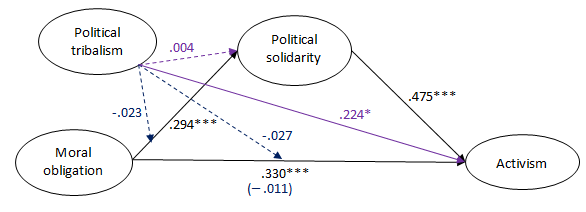
The regression analyses revealed positive and significant effects of moral obligation (c′: β = .247; z = 7.181; p < .001), political solidarity (b: β = .461; z = 7.614; p < .001), and political tribalism (β = .224; t = 2.317; p < .05) on activism. They also showed a significant positive effect of moral obligation on political solidarity (a: β = .211; t = 7.614; p < .001), whereas the effect of political tribalism on political solidarity was not significant (β = .004; t = 0.052; p > .05). In line with the recommendations of Yzerbyt et al. (2018), these results confirm the mediating role of political solidarity in the relationship between moral obligation and activism. The total effect (c = .344) is greater than the direct effect (c′ = .247), indicating partial mediation (c = c′ + ab = .247 + .097 = .344). The indirect effect (ab = .097) represents approximately 28.25% of the total effect (M% = [(ab) / c] × 100 = 28.25%).
| Type of effect | Relations | β | Standard Error | Z-value | P | |
| Direct effectIndirect effectsTotal effect | Moral obligation => ActivismObligation => Political solidaritySolidarity => ActivismObligation => Solidarity => ActivismObligation => Activism | c’ababc = c' + ab | .247.211.461.097.344 | .034.028.048.016.035 | 7.1817.6149.5585.9599.773 | < .001< .001< .001< .001< .001 |
Regarding the moderating effect, the regression analyses revealed negative but non-significant interaction effects between moral obligation and political tribalism on both political solidarity (β = −.023; t = −1.280; p > .05) and activism (β = −.027; t = −1.270; p > .05). Although these effects are not statistically significant, they suggest a tendency for political tribalism to weaken the influence of moral obligation on both political solidarity and activism. Consistent with this observation, the index of moderated mediation is negative (Index = −.011), with a confidence interval that includes zero (95% CI [−.011, .010], based on 5,000 bootstrap samples), indicating that the moderated mediation effect is not statistically significant. Furthermore, political tribalism shows a non-significant positive effect on political solidarity (β = .004; t = 0.053; p > .05) and a significant positive effect on activism (β = .224; t = 2.317; p < .05). A summary of these results is presented in Figure 1.
4. Discussion
This study aimed to explain conventional forms of protest in a repressive multi-ethnic context by examining the role of moral obligation to act, mediated by political solidarity and moderated by political tribalism. Overall, the findings largely support the proposed hypotheses. Although not all observed effects reach statistical significance, the results contribute meaningfully to understanding how political opportunity structures shape activism.
4.1. Summary of results
The first hypothesis examined the direct effect of moral obligation on activism. The findings indicate that individuals who feel a stronger moral obligation to act are more likely to participate in lawful demonstrations challenging the political status quo. These variables are positively related (r = .371, p < .001), suggesting that an increase in moral obligation corresponds to an increased willingness to engage in collective action.
Regression results further confirm that moral obligation significantly predicts activism (β = .330; t = 4.094; p < .001). This finding is consistent with the existing literature, which identifies moral obligation as a key driver of collective action ([32]; Agostini & van Zomeren, 2021) Agostini & van Zomeren, 2021), and more specifically as the proximal mechanism underlying this phenomenon in repressive contexts ([6]; [7]; [4]).
The second hypothesis aimed to test the mediating role of political solidarity in the relationship between moral obligation and activism. The results support our predictions and confirm partial mediation (|c′| = .330 < |c| = .469), alongside relatively high levels of political solidarity among respondents. As expected, a substantial proportion (28.25%) of the effect of moral obligation on activism is mediated by political solidarity. More precisely, when individuals who are not directly affected by a conflict (i.e. members of the general public) feel morally obliged to support a political cause, they become more willing to participate in peaceful demonstrations because they perceive themselves as sharing a common destiny with the protesters. Thus, in line with the literature on political solidarity, the salience of an inclusive social identity – of which political solidarity is a manifestation – acts as a facilitator of activism (Subašić et al., 2008; Subašić et al., 2011).
The final hypothesis examined the moderating role of political tribalism in the mediated relationship between moral obligation, political solidarity, and activism in a repressive multi-ethnic context. Although the effects were consistently non-significant, the results indicate that the interaction between moral obligation and political tribalism tends to reduce both political solidarity (β = −.023; t = −1.280; p > .05) and activism (β = −.027; t = −1.270; p > .05). Consistent with the moderated mediation index—which, although aligned with our expectations, remains non-significant—this hypothesis is not supported (Index = −.011; 95% CI [−.011, .010]). Interestingly, while political tribalism significantly increases activism, this effect appears to reflect a willingness to engage in demonstrations primarily on the basis of ethnic affiliation. The implications of these findings, together with the study’s limitations, are discussed below.
4.2. Implications, limitations and perspectives of the study.
“Creative wisdom and the outcomes of activists’ choices, their capacity for action, can only be understood and evaluated by examining the political context and the rules of the game in which these choices are made – that is, the structure” (Meyer, 2004, p. 128). From the perspective of political opportunity structures (see van Zomeren, 2016), changes in the political context shape individuals’ expectations regarding the success or failure of collective action. As a key dimension of the political environment that can either encourage or discourage participation [36], political opportunity – often conceptualised as political openness—refers to the extent to which institutions allow or constrain protest within a given period.
In repressive and multi-ethnic contexts, the dynamics of institutional discrimination in political competition are largely based on the combined use of systematic repression and the political instrumentalisation of ethnicity (Messanga & Taffo Nemboué, 2025; [20]; Messanga & Ekango Nzekaih, 2021). These political opportunities shape not only the likelihood of protest, but also the forms it takes – that is, the repertoire of collective action available to individuals [19].
When this repertoire includes activism – understood as a willingness to engage in legal and non-violent political action [26] – our findings highlight the importance of a salient moral obligation to act, particularly in contexts where perceived risks are heightened due to repression. However, even when individuals recognise that “acting together” (i.e. political solidarity) is the appropriate course of action, in multi-ethnic settings characterised by both repression and the political instrumentalisation of ethnicity, members of the public – especially those not directly affected – often feel exempt from participation due to political tribalism. This provides a theoretical basis for the hypothesised moderating role of political tribalism. Indeed, governing authorities may strategically manipulate identity processes by increasing or decreasing perceived social distance between groups for political purposes – for example, by fostering division, stigmatising certain groups, or privileging others along ethnic lines [31].
Individuals living in such repressive and politically tribalised environments may therefore refrain from participating in demonstrations, even when they perceive a shared fate with protesters and experience a moral obligation to act. Nevertheless, several limitations must be acknowledged, particularly with regard to measurement. The reliability of the political tribalism scale was relatively low, indicating limited internal consistency. The original instrument proposed by Messanga and Npiane Ngongueu (2021) has not yet undergone rigorous psychometric validation. While the initial scale included 16 items (with half formulated as reverse items), only four of the positively worded items demonstrated acceptable consistency in the present study. Improving this measurement instrument would likely yield more robust and reliable results.
As a phenomenon highly sensitive to contextual factors (Odağ et al., 2023), the modelling of protest behaviour must always be interpreted in relation to the political opportunity structure within which it occurs. In this respect, the present findings offer valuable perspectives for understanding social and political change in contexts characterised by limited political openness. Political tribalism, arising from the political instrumentalisation of ethnicity, appears to define a politicised identity content that prioritises the interests of readily accessible ethnic subgroups over national collective interests, the pursuit of which is often perceived as risky and uncertain. This situation places citizens in a social dilemma, representing a fundamental challenge for collective action ([30]; Gao, Geng, Mecona, Li, Mmedb, & Yan, 2024). Moreover, the consequences of political tribalism tend to exacerbate tensions, undermining what were previously harmonious societal relations.
From the perspective of identity content (Turner-Zwinkels & van Zomeren, 2021) and intersectionality theory [8], future research should explore the specific meanings associated with each subgroup identity in order to understand how these identities intersect with the content of overarching social identities. Such an approach would, for instance, clarify the extent to which self-identification with an ethno-tribal community may coexist with identification with the nation.
Furthermore, drawing on research concerning the structural characteristics of social systems [38], scholars are encouraged to investigate how collective action emerges in contexts where systematic repression and the political instrumentalisation of ethnicity operate simultaneously. This line of inquiry is particularly valuable for understanding how these two structural constraints – which shape political opportunity – may, under certain conditions, paradoxically function as significant levers for social protest.
References
- Abrams, D., & Grant, P. R. (2012). Testing the social identity relative deprivation (SIRD) model of social change : The political rise of Scottish nationalism. British Journal of Social Psychology, 51(4), 674689. DOI: 10.1111/j.2044-8309.2011.02032.x
- Adra, A., & Li, M. (2024). Répression au niveau macro et voies de résistance politique au niveau micro : Un cadre à double rôle. In F. Bou Zeineddine & J. R. Vollhardt (Éds.), Resistance to Repression and Violence : Global Psychological Perspectives (p. 0). Oxford University Press. DOI: 10.1093/9780197687703.003.0004
- Agostini, M., & van Zomeren, M. (2021). Toward a comprehensive and potentially cross-cultural model of why people engage in collective action : A quantitative research synthesis of four motivations and structural constraints. Psychological Bulletin, 147(7), 667700. DOI: 10.1037/bul0000256
- Ayanian, A. H., Adra, A., Zeineddine, F. B., Saab, R., Vollhardt, J. R., & Tausch, N. (2025). Collective Action Under Repressive Conditions : Integration of Individual, Group, and Structural Level Research, Recommendations, and Reflections. Social Issues and Policy Review, 19(1), e70000. DOI: 10.1111/sipr.70000
- Ayanian, A. H., & Tausch, N. (2016). How risk perception shapes collective action intentions in repressive contexts : A study of Egyptian activists during the 2013 post-coup uprising. British Journal of Social Psychology, 55(4), 700721. DOI: 10.1111/bjso.12164
- Ayanian, A. H., Tausch, N., Acar, Y. G., Chayinska, M., Cheung, W.-Y., & Lukyanova, Y. (2021). Resistance in repressive contexts : A comprehensive test of psychological predictors. Journal of Personality and Social Psychology, 120(4), 912939. DOI: 10.1037/pspi0000285
- Ayanian, A. H., Tausch, N., & Saab, R. (2024). Social Psychological Processes Underlying Collective Action in Repressive Contexts : What We Know and Ways Forward for Future Research. In F. Bou Zeineddine & J. R. Vollhardt (Éds.), Resistance to Repression and Violence DOI: 10.1093/9780197687703.003.0002
- Curtin, N., Stewart, A. J., & Cole, E. R. (2015). Challenging the status quo : the role of intersectional awareness in activism for social change pro-social intergroup attitudes. Psychology of woman quarterly, 39(4), 512529 DOI: 10.1177/0361684315580439
- Dzuetso Mouafo, V., Taffo Nemboué, W., & Messanga, G. (2023). When Perceived Official Terror Drives People out of Politics : A Systemic Analysis of Political Alienation in the Context of Authoritarian Democracy. Psychology and Behavioral Sciences, 12, 8898. DOI: 10.11648/j.pbs.20231206.11
- Gao, J., Geng, Y., Jiang, X., Li, J., & Yan, Y. (2024). Social dilemma for 30 years : Progress, framework, and future based on CiteSpace analysis. Medicine, 103(52), e41138. DOI: 10.1097/MD.0000000000041138
- Hayes, A. F. (2013). Introduction to médiation, modération, and conditional process, analysis : a regrssion based approach. The Guilford Press.
- Hornsey, M. J., Blackwood, L., Louis, W., Fielding, K., Mavor, K., Morton, T., O’Brien, A., Paasonen, K.-E., Smith, J., & White, K. M. (2006). Why do People Engage in Collective Action? Revisiting the Role of Perceived Effectiveness. Journal of Applied Social Psychology, 36(7), 17011722. DOI: 10.1111/j.0021-9029.2006.00077.x
- Klandermans B (1984) Mobilization and participation: Social-psychological expansions of resource mobilization theory. American Sociological Review 49: 583–600
- Lonsdale, J., & Abel, C. (1996). Ethnicité, morale et tribalisme politique. DOI: 10.3406/polaf.1996.5946
- McAdam, D. (1982). The political process and the development of black insurgency. Chicago, IL: University of Chicago Press.
- McAdam, D., & Boudet, H. (2012). Putting Social Movements in their Place : Explaining Opposition to Energy Projects in the United States, 2000–2005. Cambridge University Press. DOI: 10.1017/CBO9781139105811
- McCarthy, J. D., & Zald, M. N. (1977). Resource Mobilization and Social Movements : A Partial Theory. American Journal of Sociology, 82(6), 12121241.
- Messanga, G. A. (2018). Les relations entre l’Etat et la tribu en Afrique: Psychologie sociale des relations intergroupes chez Charles-Robert DIMI. In M. Tsalefac, J. Chatué, & A. L. Tsala Mbani (dir.), Créativité socio-politique et réécriture de soi en Afrique, Mélanges offerts au Professeur Charles-Robert Dimi (pp. 33-64). Editions Patrimoine.
- Messanga, G. A., Ayingone Obame, C., & Nzeuta Lontio, S. (2023). Instrumentality and/or Identity? Explanation of Participation in Collective Action in the Gabonese Repressive Context Based on the Dual-Pathway Model of Social Movement Participation. Journal of Social Psychology Research, 116. DOI: 10.37256/jspr.3120243013
- Messanga, G. A., Ekango Nzekaih, H. K., Taffo Nemboué, W., Npiane Ngongueu, S., Nzeuta Lontio, S., Fotso Magne, P., & Yoh Fopa, D. B. (2024). “They Should Take Care of Themselves, We Have Our Own Problems!” : The Challenges of Sympathetic Resistance in Multi-Ethnic Authoritarian Contexts. In F. Bou Zeineddine & J. R. Vollhardt (Éds.), Resistance to Repression and Violence (1re éd., p. 304324). Oxford University PressNew York, NY. DOI: 10.1093/9780197687703.003.0015
- Messanga, G. A., & Npiane Ngongueu, S. (2021). Tribalization of politics in authoritarian regimes : Analysis of the link between political tribalism and right-wing authoritarianism in Cameroon. International Journal of Research and Innovation in Social Science, 05(1), 1524.
- Messanga, G. A., & Ekango Nzekaih, H. K. (2021). Political Instrumentalization of Ethnicity and Maintenance of Social Status Quo in Multi-Ethnic Contexts. International Journal of Applied Psychology, 1(2), 4352.
- Messanga, G. A., & Nzeuta Lontio. (2020). Construction et Validation d’une Échelle d’évaluation du Tribalisme dans les Relations Intergroupes. European Scientific Journal, ESJ, 16(10), 195. DOI: 10.19044/esj.2020.v16n10p195
- Messanga, G. A., & Taffo Nemboué, W. (2025). Revisiting the analysis of the use of systematic terror from the theoretical perspective of social dominance : Concept, limits and theoretical proposition. European Review of Social Psychology. DOI: 10.1080/10463283.2025.2525003
- Meyer, D. S. (2004). Protest and political opportunities. Annual Review of Sociology, 30, 125–145
- Moskalenko, S., & McCauley, C. (2009). Measuring Political Mobilization : The Distinction Between Activism and Radicalism. Terrorism and Political Violence, 21(2), 239260. DOI: 10.1080/09546550902765508
- Neufeld, K. H. S., Starzyk, K. B., & Gaucher, D. (2019). Political solidarity : A theory and a measure. Journal of Social and Political Psychology, 7(2), 726765. DOI: 10.5964/jspp.v7i2.1058
- Odağ, Ö., Uluğ, Ö. M., Kanık, B., & Maganić, M. M. (2023). Exploring the Context‐Sensitivity of Collective Action Motivations and the Mobilizing Role of Social Media : A Comparative Interview Study With Activists in Germany and Turkey. Political Psychology, 44(2), 235255. DOI: 10.1111/pops.12836
- Opp, K.-D. (2009). Theories of Political Protest and Social Movements : A Multidisciplinary Introduction, Critique, and Synthesis. Routledge. DOI: 10.4324/9780203883846
- Ostrom, E. (1998). A Behavioral Approach to the Rational Choice Theory of Collective Action : Presidential Address, American Political Science Association, 1997. The American Political Science Review, 92(1), 122. DOI: 10.2307/2585925
- Saab, R., Ayanian, A., Adra, A., & Badaan, V. (2024). Social Psychological Dynamics of Repression and Resistance to Repression : Insights From the October 2019 Lebanese Uprising (p. 5173). DOI: 10.1093/9780197687703.003.0003
- Sabucedo, J. M., & Vilas, X. (2014). Rabia y emociones positivas en protestas políticas. Universitas Psychologica, 13(3). DOI: 10.11144/Javeriana.UPSY13-3.apep
- Subašić, E., & Reynolds, K. J. (2009). Beyond “Practical” Reconciliation : Intergroup Inequality and the Meaning of Non‐Indigenous Identity. Political Psychology, 30(2), 243267. DOI: 10.1111/j.1467-9221.2008.00690.x
- Subašić, E., Schmitt, M. T., & Reynolds, K. J. (2011). Are we all in this together? : Co-victimization,inclusive social identity and collective action in solidarity with the disadvantaged. The British Journal of Social Psychology, 50(4), 707725. DOI: 10.1111/j.2044-8309.2011.02073.x
- Sidanius, J., & Pratto, F. (1999). Social dominance : An intergroup theory of social hierarchy and oppression (p. x, 403). Cambridge University Press. DOI: 10.1017/CBO9781139175043
- Tarrow, S. (1994). Power in movement: Social movements, collective action, and mass politics in the modern state. Cam bridge, UK: Cambridge University Press.
- Tausch, N., Becker, J. C., Spears, R., Christ, O., Saab, R., Singh, P., & Siddiqui, R. N. (2011). Explaining radical group behavior : Developing emotion and efficacy routes to normative and nonnormative collective action. Journal of Personality and Social Psychology, 101(1), 129148. DOI: 10.1037/a0022728
- Teymoori, A., Bastian, B., & Jetten, J. (2017). Towards a Psychological Analysis of Anomie. Political Psychology, 38(6), 10091023. DOI: 10.1111/pops.12377
- Tilly, C. (2008). Contentious Performances (1re éd.). Cambridge University Press. DOI: 10.1017/CBO9780511804366
- Turner-Zwinkels, F. M., & van Zomeren, M. (2021). Identity expression through collective action : How identification with a politicized group and its identity contents differently motivated identity-expressive collective action in the U.S. 2016 presidential elections. Personality and Social Psychology Bulletin, 47(3), 499513. DOI: 10.1177/0146167220933406
- Uluğ, Ö. M., Chayinska, M., & Tropp, L. R. (2022). Conceptual, methodological, and contextual challenges in studying collective action : Recommendations for future research. TPM-Testing, Psychometrics, Methodology in Applied Psychology, 29(1), 922.
- van Zomeren, M. (2016). Building a Tower of Babel? Integrating Core Motivations and Features of Social Structure into the Political Psychology of Political Action. Political Psychology, 37(S1), 87114. DOI: 10.1111/pops.12322
- van Zomeren, M., Postmes, T., & Spears, R. (2008). Toward an integrative social identity model of collective action : A quantitative research synthesis of three socio-psychological perspectives. Psychological Bulletin, 134(4), 504535. DOI: 10.1037/0033-2909.134.4.504
- van Zomeren, M., Postmes, T., & Spears, R. (2012). On conviction’s collective consequences : Integrating moral conviction with the social identity model of collective action. British Journal of Social Psychology, 51(1), 5271. DOI: 10.1111/j.2044-8309.2010.02000.x
- van Zomeren, M., Postmes, T., Spears, R., & Bettache, K. (2011). Can moral convictions motivate the advantaged to challenge social inequality? Extending the social identity model of collective action. Group Processes & Intergroup Relations, 14(5), 735753. DOI: 10.1177/1368430210395637
- Vilas, X., & Sabucedo, J.-M. (2012). Moral obligation : A forgotten dimension in the analysis of collective action. International Journal of Social Psychology, 27(3), 369375. DOI: 10.1174/021347412802845577
- Yzerbyt, V., Muller, D., Batailler, C., & Judd, C. M. (2018). New recommendations for testing indirect effects in mediational models : The need to report and test component paths. Journal of Personality and Social Psychology, 115(6), 929943. DOI: 10.1037/pspa0000132